
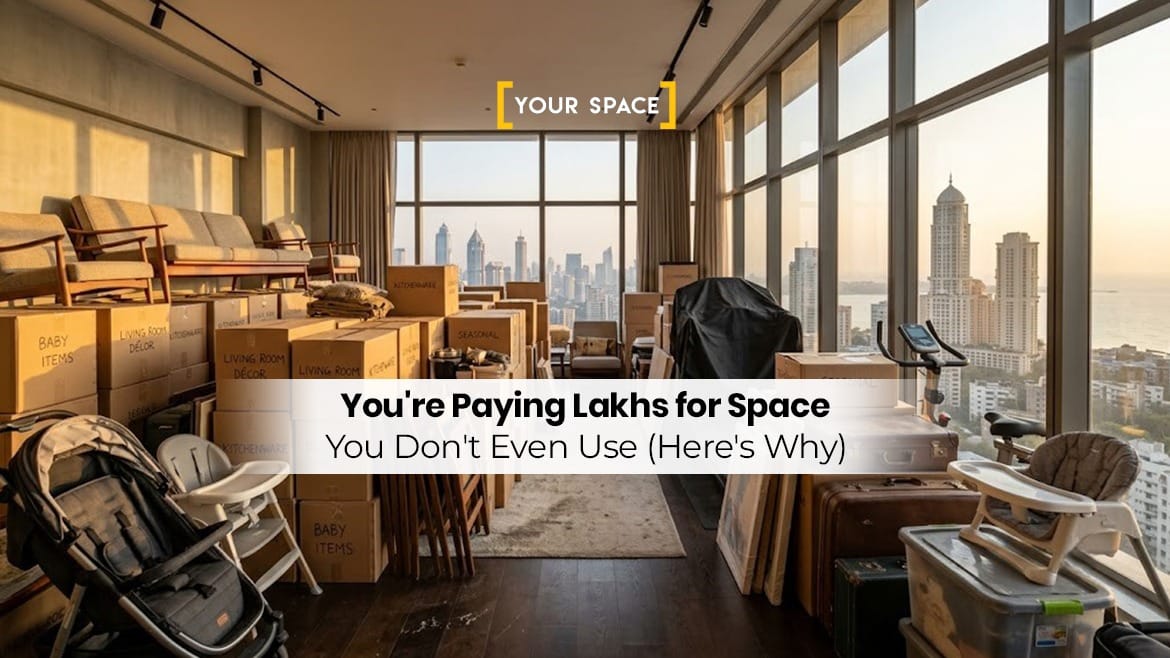
Imagine Paying ₹1 Crore… Just to Store Boxes
Let’s do a quick thought experiment.
Imagine buying a luxury storage unit.
It costs ₹1 crore.
You pay property tax.
Maintenance.
Electricity.
Repairs.
Cleaning.
EMIs.
Every single month.
Sounds ridiculous, doesn’t it?
Now here’s the surprising part.
Many homeowners are already doing exactly that.
Not because they bought a storage facility.
Because they’re using their homes to store things they rarely use.
That spare bedroom filled with unopened cartons.
The wardrobe packed with clothes that haven’t seen daylight in years.
The balcony that slowly became a parking spot for old furniture.
The loft holding boxes nobody has opened since the last move.
These spaces aren’t just occupied.
They’re expensive.
Your home isn’t only where you live.
It’s also the costliest place you’ll ever use for household storage.
And most of us don’t even realize it.
The Real Price of Every Square Foot
When buying a home, we often think about location, amenities, and floor plans.
But here’s something we rarely calculate:
How much does every square foot actually cost?
In many Indian cities, every additional square foot adds significantly to the price of a home.
Now ask yourself:
How much of that premium space is being used for living…
And how much is being used for storing things you don’t actually need every day?
A room filled with unused furniture doesn’t become less expensive simply because it’s inside your house.
You’re still paying for it.
Month after month.
Year after year.
That’s why space optimization isn’t just about making your home look bigger.
It’s about making better use of something you’ve already invested heavily in.
Your Home Was Designed for Living, Not Overflow Storage
Think about how your home was meant to be used.
The guest room was supposed to welcome family.
The study was meant for work or creativity.
The balcony was designed to bring in light and fresh air.
Even your wardrobes were created to support daily life—not become time capsules for forgotten belongings.
Yet over the years, many homes quietly change purpose.
A single box becomes five.
Five become twenty.
Soon, an entire room stops being a room.
It becomes a storage area.
And because the change happens gradually, we stop noticing it.
The Hidden Cost of Holding On to Everything
Clutter isn’t just about physical objects.
It quietly demands your time, attention, and space.
You spend weekends moving things around to clean.
You struggle to find what you’re looking for.
You buy duplicates because the original is buried somewhere.
You postpone hobbies because there’s “no room.”
You delay inviting guests because the spare room isn’t really spare anymore.
The financial cost is easy to understand.
The lifestyle cost is much harder to measure.
Not Everything Needs to Be Thrown Away
Here’s where many people get stuck.
They assume there are only two choices:
Throw it away.
Or keep it at home forever.
But life isn’t that simple.
What about:
- Family heirlooms?
- Childhood photo albums?
- Seasonal decorations?
- Festival items?
- Extra furniture?
- Sports equipment?
- Baby products you’ll need again?
- Wedding outfits?
- Business inventory?
- Important documents?
These things still matter.
They just don’t need to occupy your everyday living space.
That’s where personal storage and household storage become practical—not because you’re running out of space, but because you’re choosing to use your space more intentionally.
The Difference Between Owning and Using
One of the biggest misconceptions about storage is that if you own something, it should always stay within arm’s reach.
But think about your daily routine.
How many of the items in your home have you actually used in the last month?
Or even the last year?
Ownership doesn’t require constant visibility.
Some belongings are valuable because they’ll be useful later—not because they need to sit in your hallway today.
Creating room for your present doesn’t mean letting go of your past.
It means organizing it more thoughtfully.
When Space Starts Working for You
Imagine walking into a room where every piece of furniture has a purpose.
Cupboards close without a struggle.
Shelves display things you love instead of things you’ve forgotten.
Your dining table is for meals—not temporary storage.
The spare room is ready when family visits.
The balcony becomes a place to enjoy your morning coffee again.
The square footage hasn’t changed.
But your experience of living there has.
That’s the real power of home organization.
A Bigger Home Isn’t Always the Answer
When people begin to feel cramped, the first thought is often:
“We need a bigger house.”
Sometimes that’s true.
But sometimes the issue isn’t the size of the home.
It’s how the space is being used.
Moving to a larger property is a major financial decision.
Reclaiming the space you already have often starts with asking a simpler question:
“What really needs to stay here?”
That question alone can transform how a home feels.
Your Home Should Reflect the Life You’re Living Today
Homes evolve.
Families grow.
Careers change.
Children leave for college.
Parents move in.
Hobbies come and go.
The way we use our homes should evolve too.
Instead of letting yesterday’s belongings define today’s living space, it’s worth rethinking what deserves a permanent place and what can be stored safely until it’s needed again.
A home isn’t valuable because of how much it can hold.
It’s valuable because of how well it supports the people living in it.
Frequently Asked Questions
What is household storage?
Household storage refers to safely storing furniture, seasonal items, documents, and personal belongings to free up usable space at home while keeping everything protected.
Why is my home feeling smaller over time?
In many cases, it’s not because the home has become smaller—it’s because more belongings accumulate over the years, reducing usable living space.
Is renting a bigger house always the best solution?
Not necessarily. Reorganizing, decluttering, and using smart storage solutions can often create significant extra space without the cost of moving.
What items are suitable for personal storage?
Seasonal clothing, extra furniture, sports equipment, books, collectibles, family heirlooms, and other infrequently used belongings are common candidates.
Can storage help improve home organization?
Yes. Removing rarely used items from your everyday living areas makes it easier to organize your home and use each room for its intended purpose.
How often should I review what I’m storing at home?
A simple review every six to twelve months helps you identify items you still need, items you can donate, and belongings that are better suited for long-term storage.
Ready to Make Your Home Feel Bigger Without Moving?
Sometimes, creating more space doesn’t require buying a larger house it starts with using your existing space more wisely.
Whether you’re looking to protect seasonal belongings, store extra furniture, or simply reclaim the rooms you’ve stopped using, thoughtful household storage can help you enjoy your home the way it was meant to be lived in.
Talk to our storage experts: +91 8433925040
