
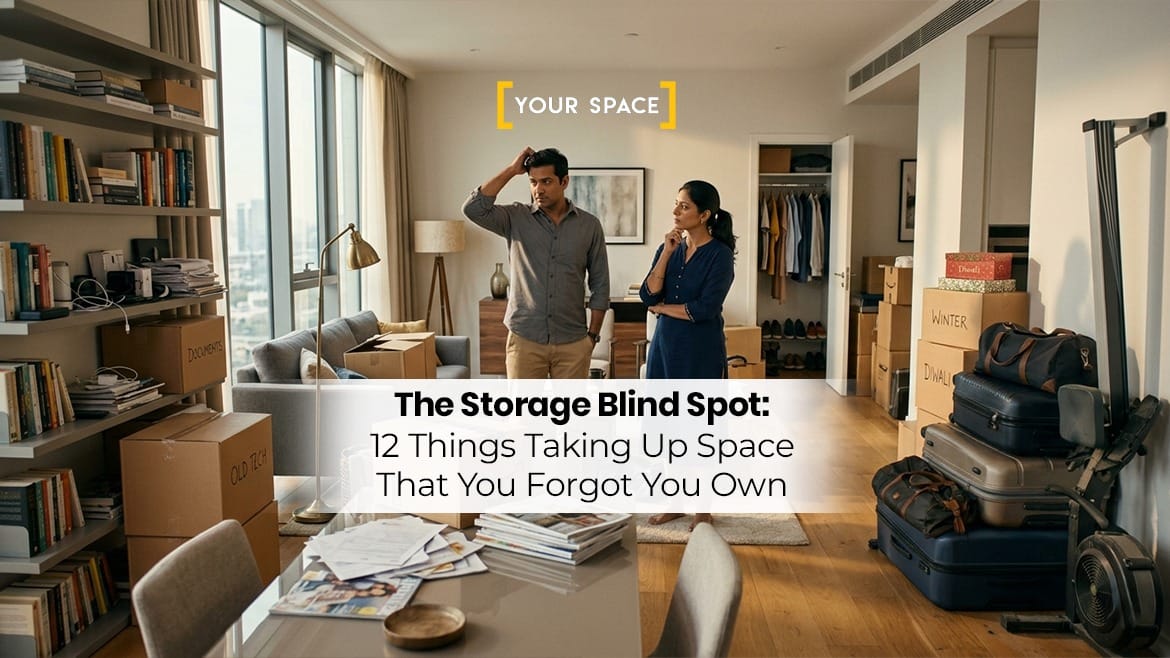
Your Home Isn’t Full. It’s Just Hiding Things from You.
Here’s a strange question.
If someone gave you an extra room tomorrow…
Would it solve your space problem?
Or would it simply become another place to store things you’ve forgotten about?
Most people immediately say:
“I need more space.”
But after a closer look, that’s usually not true.
The real problem isn’t a lack of space.
It’s a lack of visibility.
Because every home has what experts call a storage blind spot.
Items that quietly occupy space.
Not because they’re useful.
Not because they’re valuable.
But because they’ve become invisible.
You walk past them every day.
Yet somehow never notice them.
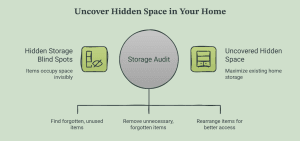
That’s why household storage, decluttering, and space optimization aren’t about creating more space.
They’re about uncovering the space you already have.
Let’s start the audit.
You may be surprised by what you’re storing.
1. The Suitcase Inside the Suitcase Inside the Suitcase
Open your wardrobe.
You probably have luggage.
Inside that luggage?
More bags.
Inside those bags?
Even more bags.
This is one of the most common storage blind spots.
Travel items often become permanent residents in valuable living space.
2. The Chair That Stopped Being a Chair
Every home has one.
The chair.
Not for sitting.
For clothes.
Half-clean clothes.
Maybe-clean clothes.
Definitely-not-dirty-enough-to-wash clothes.
At some point, the chair quietly changed jobs.
And nobody noticed.
3. The Kitchen Appliance Used Once a Year
Let’s be honest.
When was the last time you used:
- that giant juicer
- the party-sized serving tray
- the extra mixer
- the specialty baking machine
These appliances consume prime kitchen real estate.
While being used maybe twice a year.
4. The Drawer Full of Mystery Cables
Nobody knows what they’re for.
Nobody knows if they work.
Yet somehow they’re impossible to throw away.
Most homes contain:
- charger cables
- adapters
- outdated connectors
- mystery electronics
All living rent-free for years.
5. The Exercise Equipment Retirement Home
It started with motivation.
Then reality happened.
Now the equipment sits quietly in a corner.
Becoming expensive furniture.
This is one of the biggest examples of how clutter accumulates through good intentions.
6. The Seasonal Decoration Collection
Holiday decorations are important.
But do they need everyday access?
Probably not.
Decorations often occupy cupboards year-round despite being used only a few days annually.
7. The Box of “Important Papers”
This one feels productive.
But often contains:
- expired warranties
- old manuals
- outdated statements
- duplicate paperwork
Document clutter grows slowly.
Which is why it often escapes attention.
8. The Wardrobe Time Capsule
Everyone has clothes for:
- when they lose weight
- when trends come back
- special occasions
- “just in case”
The problem?
Wardrobes become museums of past versions of ourselves.
Instead of spaces that support present-day living.
9. The Storage Containers Storing Nothing
This one is ironic.
Empty storage containers.
Empty boxes.
Unused organizers.
Storage products themselves often become clutter.
10. The Sentimental Box Nobody Opens
Old photos.
Cards.
School projects.
Memories.
These items matter.
But they often sit in awkward places because nobody knows where they belong.
The answer isn’t throwing them away.
It’s storing them intentionally.
11. The Furniture Nobody Actually Uses
Every home has at least one piece.
The extra table.
The decorative cabinet.
The chair no one sits in.
It occupies space daily while serving almost no practical purpose.
12. The “I’ll Deal With It Later” Corner
This is the ultimate blind spot.
The corner.
The shelf.
The surface.
The pile.
The area where decisions go to wait.
And somehow…
it keeps growing.
Why These Blind Spots Matter More Than You Think
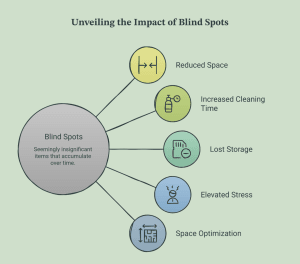
None of these items seem significant individually.
That’s what makes them dangerous.
One chair.
One box.
One appliance.
One shelf.
No big deal.
Until all of them exist together.
Then suddenly:
- rooms feel smaller
- cleaning takes longer
- storage disappears
- stress increases
This is why space optimization and household storage solutions are so powerful.
Because the goal isn’t to remove everything.
It’s to make room for what actually matters.
The 15-Minute Storage Audit Challenge
Set a timer.
Walk through your home.
Ask yourself one question:
“Would I notice if this disappeared for the next six months?”
If the answer is no…
You’ve found a storage blind spot.
Repeat this process room by room.
The results are usually eye-opening.
The Best Homes Aren’t Empty. They’re Intentional.
This is important.
Decluttering isn’t about owning less.
It’s about being aware.
Aware of what takes up space.
Aware of what serves a purpose.
Aware of what quietly consumes your home without adding value.
Because most people don’t need bigger homes.
They need fewer blind spots.
Before You Start Decluttering, Read This
What is a storage blind spot?
A storage blind spot is an item or group of belongings that occupies space but is rarely noticed or used.
How do I identify clutter in my home?
Start by looking for items you haven’t used in the last six to twelve months.
What is the fastest way to declutter?
Focus on one room at a time and identify items that no longer serve a practical purpose.
Does household storage help reduce clutter?
Yes. Household storage creates dedicated space for seasonal, sentimental, and occasionally used belongings.
Why does my home feel crowded even when it’s clean?
Hidden clutter and underused belongings often create a feeling of limited space despite a tidy appearance.
What Was Your Biggest Storage Blind Spot?
Most people discover at least three things they completely forgot they owned.
The real question is:
What did you find?
Call us: +91 8433925040
