

Your visa is approved. Your flight is booked. You’ve told your friends, informed your family and probably started watching videos about life in your new country. Exciting? Absolutely.
But then you look around your Mumbai home. The sofa is still there. The refrigerator isn’t going to fit into your suitcase. Your wardrobe is full, your books have somehow multiplied, and the family photo albums aren’t exactly carry-on friendly. Suddenly, the biggest question isn’t what you’ll pack for the flight. It’s what you’ll do with everything you’re leaving behind.
If you’re moving abroad from Mumbai for higher studies, a new job, a temporary assignment or a long-term relocation, deciding what happens to your belongings deserves a little planning. Selling everything might feel drastic. Leaving it all behind might be risky. Asking relatives to accommodate half your apartment? That could be a difficult family conversation.
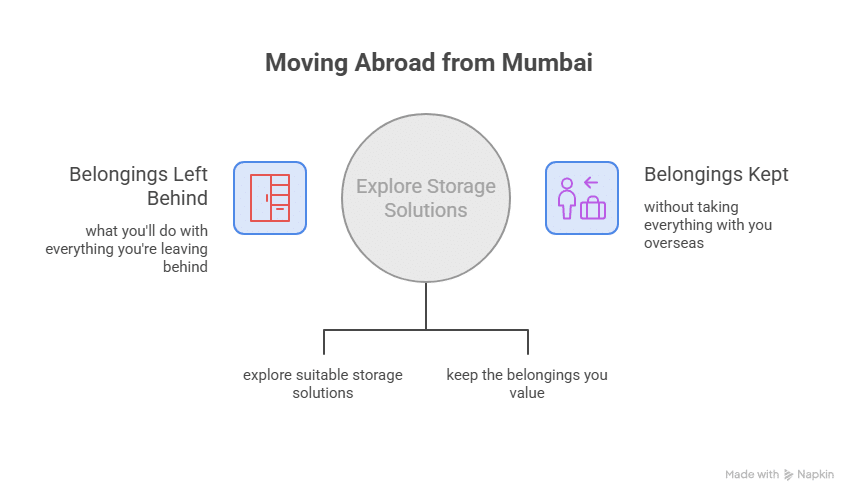
The good news is that you have another option: explore suitable storage solutions that let you keep the belongings you value without taking everything with you overseas.
1. Moving Abroad Is Exciting. Sorting Your Entire Home? Not So Much.
International relocation involves plenty of moving parts: travel documents, accommodation, banking, packing, travel arrangements and figuring out what life will look like in another country. Then comes the home.
Mumbai apartments often have to accommodate a surprising amount of life within a limited footprint. Furniture, appliances, seasonal clothing, kitchen equipment, personal collections and everyday essentials all need their own space. When you’re leaving for several months or years, keeping everything in an empty apartment may not make practical or financial sense. And if your family plans to rent out the property while you’re away, clearing your belongings becomes even more important.
Why planning storage matters before departure
Leaving household items unattended for a long time can expose them to avoidable risks, depending on the property and storage conditions. Moisture, humidity, water seepage and pests may affect vulnerable furniture, fabrics, documents and electronics. There is also the question of access. What happens if you need an important document, a family keepsake or a particular household item while you’re overseas?
A storage plan helps you think through these questions before the flight date turns everything into a last-minute scramble. The objective isn’t to store everything you own. It’s to decide what deserves to be kept, what you need to take, and what you can comfortably part with.
2. Sell It, Leave It or Store It? Choose Before You Pack
When people begin preparing for international relocation, they often consider three options: sell their belongings, leave them with family or friends, or keep them in storage. Each can work in the right situation. The trick is understanding the trade-offs.
Option 1: Sell furniture and household items
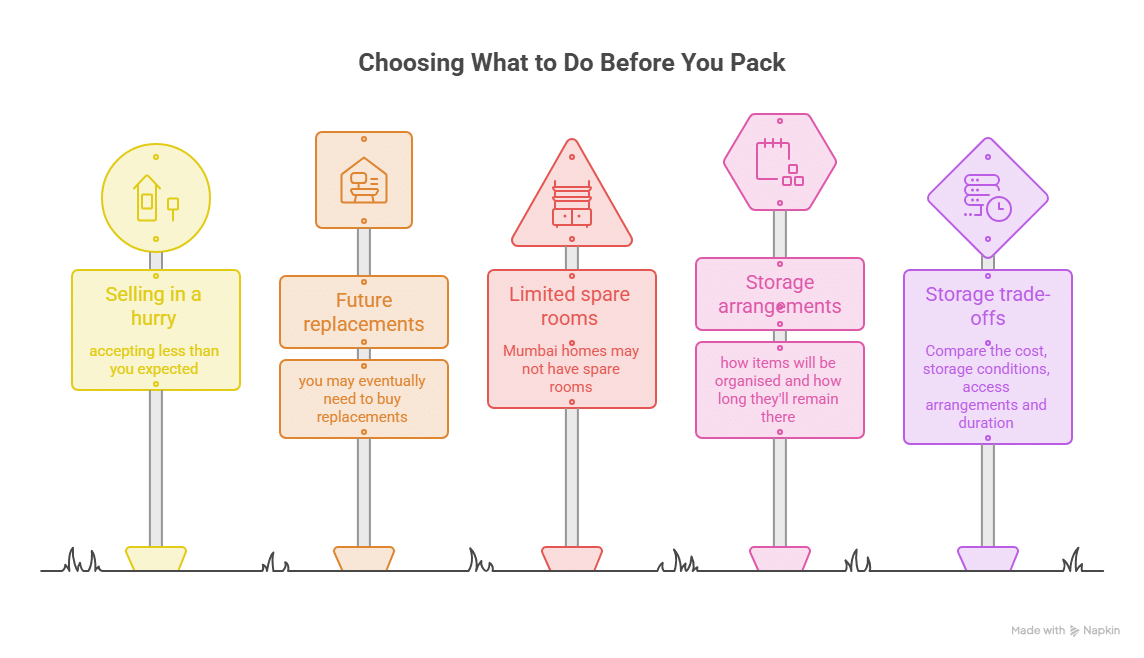
Selling can make sense for items you no longer need. It reduces the amount you have to manage and can put some money back in your pocket. But selling everything in a hurry can mean accepting less than you expected. And if you plan to return to Mumbai, you may eventually need to buy replacements.
Before selling furniture or household items, consider whether the cost of replacing them later would outweigh the benefit of selling now.
Option 2: Leave your belongings with family or friends
This can be a convenient solution for a few boxes or selected personal items. However, storing an entire household is a different matter. Mumbai homes may not have spare rooms for furniture, appliances, cartons and belongings from another apartment.
Before choosing this option, agree on how much space you’ll use, how items will be organised and how long they’ll remain there.
Option 3: Explore temporary or long-term storage
Storage may be a practical alternative when you want to retain your belongings without occupying your home or relying on someone else’s available space. Depending on the provider, options may include transporting your items to a storage facility yourself or arranging a service with collection and delivery.
Compare the cost, storage conditions, access arrangements and duration before making a decision. The best option is the one that makes financial sense for your plans—not simply the one that gets everything out of your apartment fastest.
3. What Should You Store Before Moving Abroad?
Here’s where a room-by-room approach helps. Instead of packing randomly, walk through your home and identify what you’ll genuinely need overseas and what can remain in Mumbai.
Furniture and bulky household items
Beds, mattresses, sofas, recliners, dining tables, chairs, wardrobes and storage units can take up substantial space. If you’re renting out your apartment, moving into temporary accommodation or returning to Mumbai later, furniture storage may be worth considering.
Measure larger items and check whether they need dismantling before transportation. Ask the storage provider about suitable packing, handling and storage conditions.
Appliances and white goods
Washing machines, refrigerators and other household appliances may be expensive to replace. Before storing them, follow the manufacturer’s instructions for preparation and storage. Appliances may need to be emptied, cleaned, dried and disconnected appropriately.
Not every storage facility is suitable for every appliance, so confirm acceptance and storage conditions before arranging transport.
Clothes, books and personal belongings
Clothing, shoes, books, kitchen equipment, hobby supplies and other personal belongings may be easier to store in labelled cartons. Group similar items together and use suitable packing materials. Make sure everything is clean and dry before packing, particularly textiles and paper-based items.
Keep a record of what goes into each box so you don’t have to open every carton when you need something later.
Documents and important files
Property papers, educational certificates, legal records and other important documents require particular care. Keep essential travel and identity documents with you. For records that can be stored, use appropriate protective packaging and confirm the facility’s security, environmental conditions and retrieval arrangements.
For highly sensitive originals, consider whether a trusted person or a dedicated document-storage service is more appropriate.
Business inventory and equipment
If you’re a business owner or professional relocating overseas, you may also need to manage office equipment, packaging materials, display items, stock or other business belongings. Separate business inventory from personal belongings, maintain accurate records and consider whether your business requires access to any of these items while you’re away.
The right storage arrangement depends on the nature of the goods and any special conditions they require.
4. Moving Abroad from Mumbai During Monsoon? Think Beyond the Boxes
Mumbai’s monsoon adds another consideration to long-term storage. Humidity, dampness and water seepage can affect belongings if they’re left in unsuitable conditions. Wooden furniture, mattresses, books, documents, fabrics and certain electronics may be particularly vulnerable.
That doesn’t mean every item will be damaged simply because it’s stored during monsoon. The actual risk depends on the property’s condition, packaging, ventilation and the environment in which the belongings are kept.
How to prepare your belongings
Clean and thoroughly dry items before packing them. Avoid wrapping damp fabrics or mattresses for long periods. Use suitable protective packaging and keep cartons away from known damp areas. For wooden furniture, follow appropriate preparation and care guidance. For electronics and appliances, use the manufacturer’s recommendations.
If you’re comparing storage options, ask about the facility’s moisture management, pest-control practices, cleanliness and suitability for the specific belongings you want to store. A cardboard box is packaging, not a complete long-term protection strategy. Choose storage conditions based on what’s inside the box—not just the box itself.
5. What Is Valet Storage in Mumbai, and Is It Right for You?
If you’ve been searching for valet storage in Mumbai, the term generally refers to a storage arrangement where the provider handles some or all of the logistics, such as collection, inventory recording, storage and return delivery. Unlike a traditional self-storage arrangement where you may be responsible for transporting your belongings to the facility, a valet-style service can reduce the amount of physical coordination required from you.
The exact service varies by provider. Doorstep pickup, professional packing, item-level inventory, private storage units and on-request delivery should be confirmed rather than assumed.
How does a valet-style storage service work?
A typical process may involve the following steps:
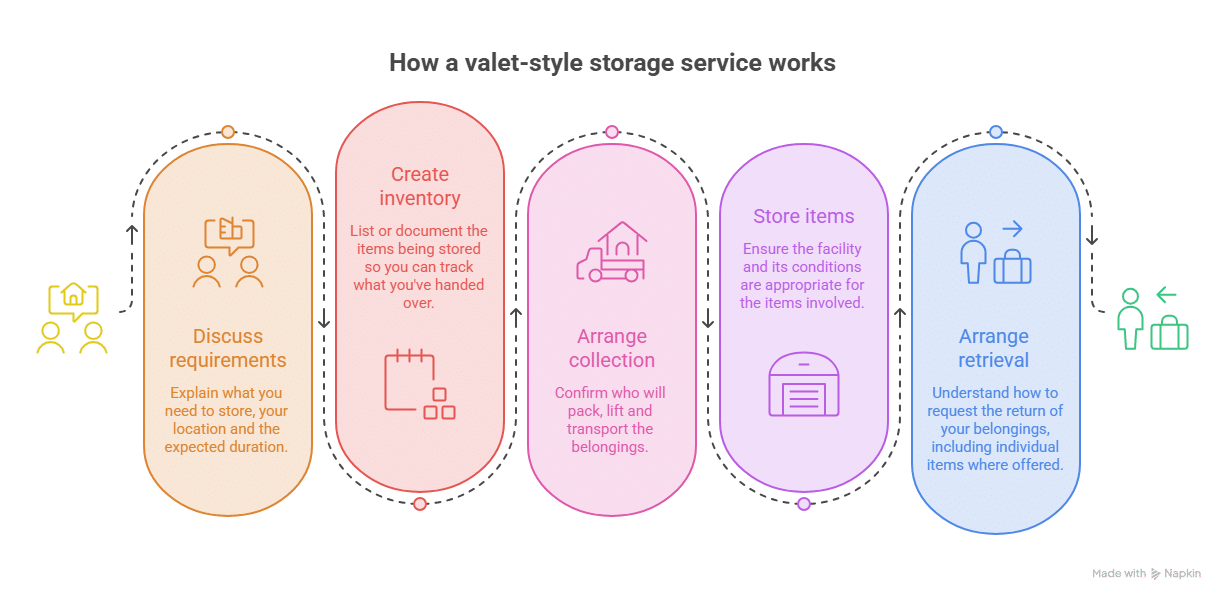
Step 1 – Discuss your requirements: Explain what you need to store, your location and the expected duration.
Step 2 – Create an inventory: List or document the items being stored so you can track what you’ve handed over.
Step 3 – Arrange packing and collection: Confirm who will pack, lift and transport the belongings.
Step 4 – Store the items: Ensure the facility and its conditions are appropriate for the items involved.
Step 5 – Arrange retrieval: Understand how to request the return of your belongings, including individual items where offered.
This kind of arrangement may be useful when you’re moving abroad, working to a tight departure schedule or simply don’t want to coordinate multiple trips across Mumbai.
What should you check before choosing a provider?
Ask about pickup and delivery coverage, packing services, inventory management, security arrangements, storage duration, retrieval fees and the terms governing damage or loss. Also confirm whether the provider accepts bulky furniture, appliances, documents and other specific items.
The phrase valet storage Mumbai can describe different service models, so compare the actual inclusions rather than relying on the label alone.
6. Going Abroad for Studies? Don’t Make Permanent Decisions in a Temporary Phase
For students, moving overseas is often the beginning of a new chapter. You’re figuring out accommodation, university schedules, budgets and what life will be like in a different country. You may not know whether you’ll return to Mumbai during the holidays, stay overseas after graduation or move to another city. That uncertainty makes it difficult to decide what to do with everything at home.
Selling your furniture and belongings may seem like the easiest option, but some items may still be useful when you return. Meanwhile, leaving everything in your family home may not be practical if the space is needed for other purposes.
Storage for students going abroad from Mumbai
Students can start by separating their belongings into three groups: items to take overseas, items to sell, donate or give away, and items to keep for a possible return. The third group is where storage may be worth exploring.
Books, selected personal belongings, seasonal items and suitable furniture can be assessed individually. Compare the likely cost of storage with the cost of replacement and the probability that you’ll need the items later.
If you’re searching for storage units for international moves, confirm whether the provider offers short-term or long-term plans, how access works and whether delivery can be arranged when you return. You don’t need to make every decision about your future on the same day you pack your suitcase.
7. Renting Out Your Mumbai Home? Your Belongings Need a Plan
If your apartment will be rented out while you’re abroad, clearing your personal belongings becomes more than a decluttering exercise. Furniture, personal documents, family heirlooms and other private items may need to be removed before tenants move in. Leaving everything locked inside the property may limit how the space can be used and can complicate maintenance or access arrangements.
Create a simple household storage plan
Start with an inventory of the belongings you intend to retain. Decide which items will travel with you, which will be stored and which will be sold or donated. Then assess the size and nature of the storage requirement.
For large furniture, consider dimensions and handling. For smaller belongings, use clearly labelled cartons. For important documents and valuables, make specific arrangements that reflect their sensitivity and access needs.
If you need to clear the apartment quickly, ask potential providers about collection availability, packing arrangements and the amount of notice required. Planning this before the tenant’s move-in date can make the transition much smoother.
8. How to Prepare Your Belongings for Long-Term Storage
A little preparation now can save you confusion when you return to Mumbai months or years later.
Declutter before storing
Sort items into four categories: take, store, sell or donate, and dispose of. Decluttering before arranging storage in Mumbai can reduce the volume of belongings you need to keep, which may also affect your storage costs.
Be realistic about what you’ll use again. But don’t feel compelled to discard valuable or sentimental items simply because you can’t take them overseas.
Label every box clearly
Use specific descriptions rather than vague labels such as “miscellaneous.” For example, “Winter clothes,” “Kitchen equipment” or “Books — study room” makes the contents easier to identify. Keep a separate inventory of boxes and larger items. If possible, take photographs of the items before packing.
Keep essentials separate
Passports, visas, educational documents, medication, financial records and anything you’ll need immediately should remain accessible to you. Don’t place important travel essentials into storage simply because they’re being packed on the same day as the rest of your home.
Confirm the storage conditions
Different belongings have different requirements. Ask about security, moisture management, pest-control measures, access and item restrictions. If your belongings need special conditions, confirm that the provider can meet those needs before arranging collection.
Plan for your return
Think about how and when you’ll retrieve your belongings. Will you need everything delivered at once? Will you be moving into a furnished apartment? Might you need a few boxes before the rest? Understanding these possibilities in advance can help you choose a more suitable storage arrangement.
9. How Much Does Storage Cost in Mumbai?
Storage costs depend on several factors, including the volume of belongings, the duration, transportation, packing requirements and the services included. Storing a few cartons is different from storing a complete household with wardrobes, beds, appliances and a dining set. Before choosing a storage provider, request a clear quote that explains the pricing structure and any additional charges.
What affects the cost?
Volume of belongings: Larger items and more cartons generally require more storage capacity.
Storage duration: Short-term and long-term arrangements may have different pricing structures or minimum periods.
Packing and handling: Confirm whether packing materials, dismantling, loading and unloading are included.
Pickup and delivery: If doorstep pickup or return delivery is available, ask how the charges are calculated.
Access and retrieval: Check whether you can request individual items, how much notice is required and whether extra fees apply.
Special storage requirements: Delicate or sensitive items may need particular handling or environmental conditions.
Compare the total cost with your alternatives. Selling furniture quickly, paying for a larger home or replacing household goods later can also have financial implications. The right decision depends on your plans, budget and how much value you place on keeping your belongings.
10. Frequently Asked Questions
Can I store my belongings in Mumbai while living abroad?
Potentially, yes. Storage arrangements may be available for short-term or long-term needs. Confirm the provider’s storage conditions, accepted items, pricing and retrieval process before committing.
Can I get individual items delivered while I’m overseas?
Some providers may offer item-level retrieval or delivery, but this isn’t universal. Ask about the process, delivery locations, lead times and additional charges.
Is furniture storage in Mumbai suitable during monsoon?
It depends on the storage environment and the preparation of the furniture. Ask about moisture management, packaging, facility conditions and the suitability of the space for your particular items.
What is the difference between self-storage and valet storage?
In a typical self-storage arrangement, customers may transport their belongings to the facility and manage access themselves. Valet-style storage may include collection and other handling services. Exact inclusions vary by provider.
Can students use storage when moving abroad?
Storage may help students retain belongings they don’t need overseas but may want when they return. Compare storage costs with replacement costs and confirm the minimum duration and retrieval arrangements.
What belongings should I avoid putting into storage?
Restrictions vary by provider. Hazardous materials, perishable goods, illegal items and certain valuables or sensitive products may be prohibited or require specialised arrangements. Always check the provider’s accepted-items policy.
11. You Take the Next Step. Your Belongings Can Wait Safely.
Moving abroad is a big enough life change without having to decide the fate of every chair, book and kitchen appliance in your home. Some things should travel with you. Some are ready for a new owner. And some deserve to wait in Mumbai until you’re ready to use them again.
With a little planning, you can make those decisions without rushing, protect the belongings that matter and leave your home better prepared for the months ahead.
If you’re exploring household storage in Mumbai, Your Space offers storage solutions for individuals and businesses. Get in touch to discuss what you need to store, how long you may need storage, and which options are suitable for your belongings and location.
Call Your Space: +91 8433925040
Your next chapter may be thousands of kilometres away. Your belongings deserve a plan, too.
