

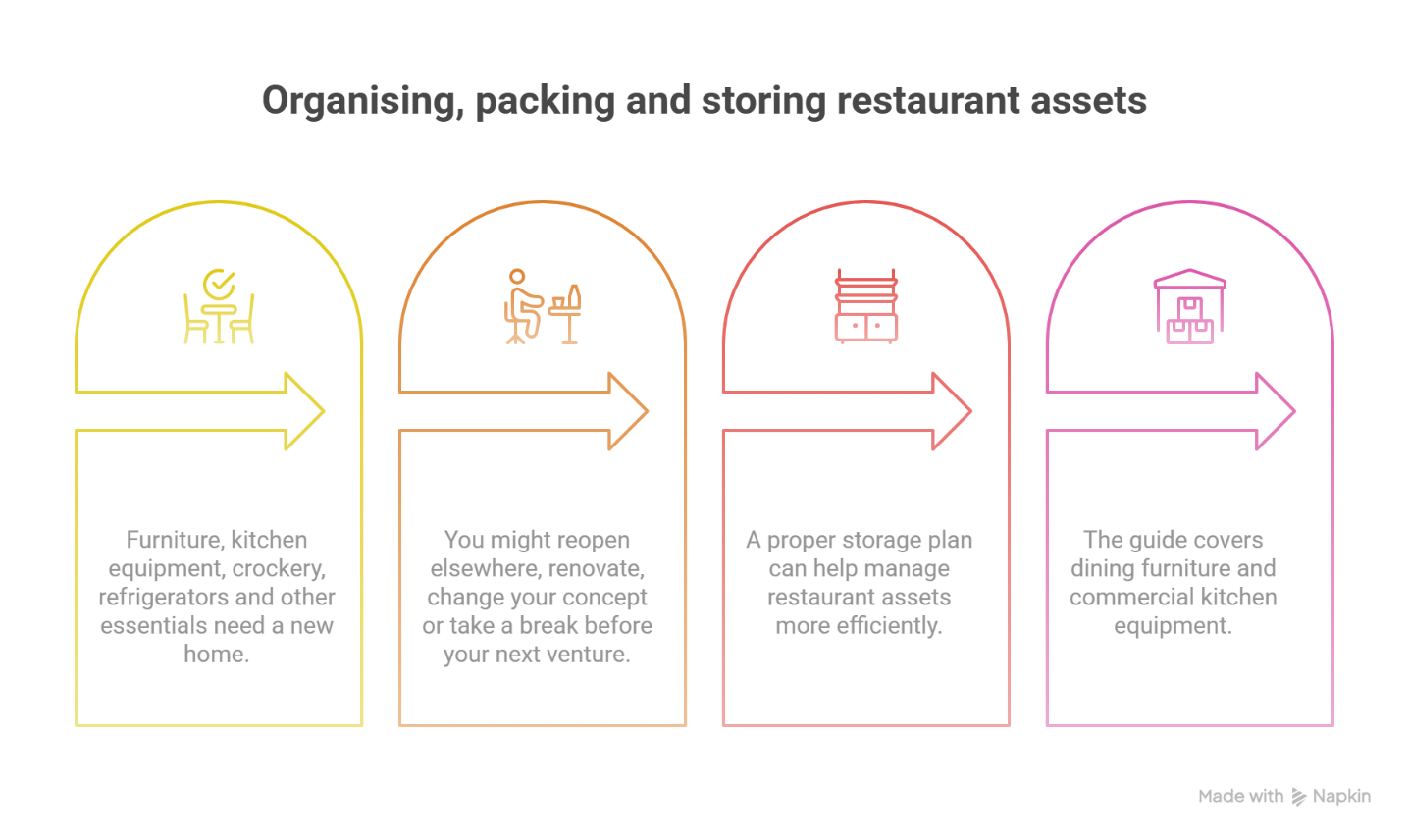
Closing a restaurant is never just about switching off the lights and handing over the keys.
There’s the furniture to move, the kitchen equipment to disconnect, the crockery to pack, the refrigerators to empty and an entire collection of restaurant essentials that suddenly need a new home.
Think about it. What happens to those 40 dining chairs? Where will the commercial oven go? What do you do with hundreds of plates, glasses, serving bowls, tables, counters and kitchen accessories?
Selling everything immediately isn’t always an option. You might be planning to reopen at another location, renovate your existing space, change your restaurant concept or simply take a break before your next business venture. And that’s where things get tricky.
Your restaurant may be closing, but your belongings still need somewhere to go.
Whether you’re shutting down permanently, relocating, renovating or temporarily suspending operations, having a proper storage plan can help you manage your restaurant assets more efficiently.
Let’s look at how to organise, pack and store everything from dining furniture to commercial kitchen equipment.
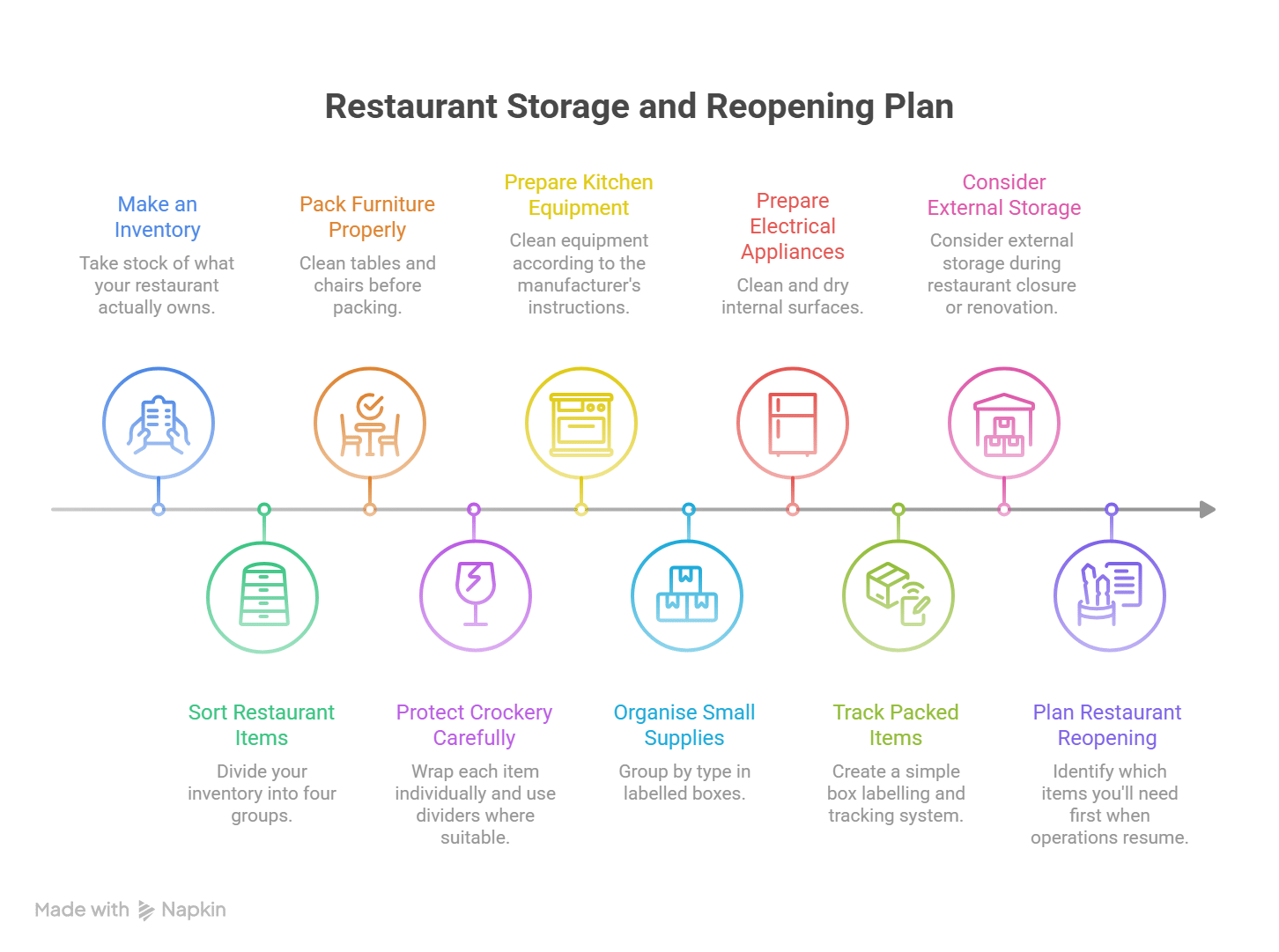
1. Start by Making an Inventory of Everything in Your Restaurant
Before moving anything, take stock of what your restaurant actually owns. Over time, restaurants accumulate far more items than owners realise. From dining furniture and kitchen appliances to crockery, cutlery, décor and electrical equipment, there’s a lot to account for.
Start by dividing your belongings into different categories:
Dining area inventory: dining tables and chairs, sofas and lounge furniture, reception counters, bar stools and display units, and decorative lighting and wall fixtures.
Kitchen inventory: commercial ovens, cooking ranges and burners, refrigerators and freezers, stainless steel worktables, mixers, grinders and food processors, and kitchen utensils and accessories.
Restaurant supplies: plates, bowls and serving dishes, glasses and cups, cutlery and serving spoons, trays and containers, and storage racks and shelves.
Other business assets: computers and billing systems, POS equipment, office furniture, menu boards and signage, and decorative items and artwork.
Create a simple inventory spreadsheet with the item name, quantity, condition and intended next step. This will help you decide what should be sold, donated, moved to your new location or placed in storage.
2. Decide What to Sell, Keep, Donate or Store
Not everything from your restaurant needs to go into storage. Some items may be useful for your next restaurant, while others may no longer fit your requirements.
Before packing, divide your inventory into four groups:
Keep: items you plan to use at your next location.
Store: furniture and equipment you may need in the future.
Sell: items you no longer require but are still usable.
Donate or dispose: suitable items you don’t intend to retain.
For example, if you’re relocating your restaurant, you may want to keep your dining tables, commercial kitchen equipment and serving inventory. But if you’re changing from a large dine-in restaurant to a smaller takeaway format, you may not need all your existing furniture.
Similarly, if you’re planning a complete renovation, storing your existing assets temporarily may make more sense than purchasing everything again.
The idea is to avoid paying to store things you don’t actually need.
3. Pack Dining Tables, Chairs and Restaurant Furniture Properly
Restaurant furniture is often one of the biggest storage challenges. Tables, chairs, sofas and counters can occupy considerable space, especially when you’re dealing with a large dining area. Simply stacking everything together can result in scratches, dents or damaged edges.
Here are some practical ways to prepare restaurant furniture for storage. Clean tables and chairs before packing, and remove detachable legs or accessories where possible. Use suitable furniture covers, protect corners and edges with padding, and wrap delicate surfaces separately. Avoid stacking furniture that isn’t designed to be stacked, and keep screws, bolts and detachable fittings in labelled bags.
For wooden furniture, make sure surfaces are clean and completely dry before covering them. Upholstered chairs and sofas should also be properly cleaned and dried before storage.
If you’re storing glass-top tables, mirrors or other fragile furniture, use appropriate protective packaging and make sure they are handled and positioned safely.
A little preparation can help protect furniture that may be expensive or difficult to replace.
4. Pack Crockery, Glassware and Cutlery Without Damage
Now comes one of the trickiest parts: the crockery. Restaurants often have large quantities of plates, bowls, cups, glasses and serving dishes. And unlike furniture, these items can break easily if they’re packed carelessly.
Imagine opening a storage box six months later and finding that half your dinner plates didn’t survive the journey. Not a great discovery.
Follow these packing tips:
For plates and dishes: clean and dry everything before packing. Place protective paper or suitable cushioning between individual pieces, use sturdy boxes, avoid overfilling cartons and label boxes as fragile.
For glasses and cups: wrap each item individually and use dividers where suitable. Keep delicate glassware separate from heavier crockery, and fill empty spaces with appropriate cushioning.
For cutlery and serving accessories: sort items by type, pack them in smaller containers and use labelled boxes for easy identification.
Keep heavier boxes at the bottom during stacking and lighter, fragile cartons above them. Also, make sure that packed boxes can be lifted safely. Large cartons filled with crockery can become surprisingly heavy.
5. Prepare Commercial Kitchen Equipment for Storage
Commercial kitchen equipment can represent a significant investment for a restaurant. Ovens, cooking ranges, refrigerators, freezers, mixers, grinders and stainless steel workstations all require careful preparation before being moved.
Unlike ordinary household items, commercial kitchen equipment may have specific cleaning, disconnection and handling requirements.
Before packing: remove all food, ingredients and perishable materials. Clean equipment according to the manufacturer’s instructions and make sure appliances are completely dry where required. Arrange professional disconnection of gas and electrical connections, secure removable parts and accessories, and protect exposed surfaces and delicate components. Keep instruction manuals and essential accessories together.
For refrigerators and freezers, empty and defrost them as instructed by the manufacturer. Clean and dry their interiors before storage, and follow the manufacturer’s recommendations for keeping doors during storage.
Gas appliances should be disconnected by qualified professionals.
Important: Not every storage facility is suitable for commercial appliances. Check power requirements, ventilation, handling restrictions and any other conditions before choosing a storage arrangement.
6. Don’t Forget Small Kitchen Accessories and Restaurant Supplies
When restaurant owners think about shifting or closing their premises, they often focus on large equipment. But what about the hundreds of smaller items?
Ladles, knives, chopping boards, pans, containers, serving trays, kitchen tools and storage accessories can quickly add up. These items may not take up much space individually, but collectively they can fill several cartons.
A simple organisation system can help:
Cooking utensils: group by type in labelled boxes.
Pots and pans: clean, dry and stack carefully with suitable protection.
Knives: use appropriate blade guards or protective packaging.
Food containers: clean and dry before stacking.
Serving trays: separate by size and protect delicate finishes.
Kitchen accessories: use smaller labelled cartons.
Shelving accessories: keep fittings and hardware together.
Avoid packing unused food, opened ingredients or perishable supplies into long-term storage cartons. Dispose of or redistribute food items appropriately before closing the kitchen.
7. Create a Separate Plan for Refrigerators, Freezers and Electrical Appliances
Restaurant appliances deserve special attention because they may be bulky, expensive and sensitive to incorrect handling. Refrigerators, deep freezers, dishwashers, microwaves and other electrical equipment should be prepared according to their individual requirements.
Consider the following. Empty all appliances completely, remove detachable trays and accessories where appropriate, and clean and dry internal surfaces. Defrost refrigerators and freezers according to the manufacturer’s instructions, and secure loose components for transportation. Protect doors, handles and external surfaces, and arrange suitable transportation for heavy equipment.
For large commercial appliances, professional movers may be needed to ensure safe handling. Before choosing a storage facility, confirm whether it can accommodate the appliance dimensions and whether its environment meets the manufacturer’s storage requirements.
A refrigerator that is simply switched off and left in a corner isn’t necessarily ready for long-term storage.
8. Maintain an Inventory of Packed Restaurant Items
Once everything has been cleaned, sorted and packed, the next challenge is knowing where each item is.
Imagine reopening your restaurant and needing to locate a particular set of serving plates or kitchen equipment. If every carton looks the same, retrieving the right items can become frustrating.
Create a simple box labelling and tracking system. For example: Box 01 – Dinner plates and serving dishes; Box 02 – Glassware and cups; Box 03 – Cutlery and kitchen tools; Box 04 – Small appliances and accessories; Box 05 – Restaurant décor; Equipment 01 – Commercial oven; Equipment 02 – Stainless steel workstation.
You can also photograph the contents before sealing each carton and maintain a digital inventory. Record the storage location, quantity and condition of important assets. This makes it easier to identify and retrieve items when you relocate, reopen or renovate your restaurant.
9. Consider External Storage During Restaurant Closure or Renovation
Sometimes, your restaurant may need to close temporarily without you wanting to sell or dispose of everything inside it. Perhaps you’re renovating the premises, relocating to a larger property, changing the restaurant concept or waiting for a new location to become available.
In such situations, keeping all your furniture and equipment at home or inside a small office may not be practical.
External storage can be worth considering for items such as dining tables and chairs, restaurant sofas and counters, crockery and serving equipment, commercial kitchen appliances, kitchen utensils and accessories, display units and decorative pieces, office furniture and business records, and non-perishable restaurant supplies.
Before selecting a storage solution, consider:
- Quantity of belongings: estimate how much space your restaurant assets will occupy.
- Storage duration: decide whether you need temporary storage during renovation or longer-term storage.
- Equipment requirements: check whether the facility can accommodate bulky appliances and fragile items.
- Access requirements: consider how frequently you may need to retrieve your belongings.
- Handling and transportation: plan how furniture, crockery and kitchen equipment will be packed, moved and unloaded.
- Storage conditions: check that the environment is suitable for the materials and equipment being stored.
The right arrangement can help you keep your restaurant assets organised without allowing them to take over your home or office.
IMAGE – Warehouse storage: Alt text: Restaurant furniture, cartons and commercial kitchen equipment organised inside a storage facility
10. Plan Ahead If You Intend to Reopen Your Restaurant
Closing one restaurant doesn’t necessarily mean you’re done with the business. You might be planning to reopen at another location, launch a different concept or return after a renovation. If that’s the case, your storage plan should also consider your future setup.
Before putting everything away, identify which items you’ll need first when operations resume, such as frequently used kitchen equipment, dining furniture, essential crockery and cutlery, billing and office equipment, menu boards and signage, and reusable decorations and fixtures.
Keep your inventory records updated and group items according to the department or area where they’ll be used. You can also maintain a priority list for reopening:
High priority: essential kitchen equipment and basic furniture.
Medium priority: crockery, serving supplies and additional equipment.
Low priority: decorative items, seasonal accessories and spare inventory.
This can help make the transition from storage to reopening more organised. Because when your next restaurant is ready to welcome customers, you don’t want to spend the first week searching through hundreds of cartons.
Frequently Asked Questions About Restaurant Closure Storage
1. What should I do with restaurant furniture when closing my restaurant?
Start by checking the condition of your furniture and deciding what you want to sell, keep or store. Clean tables and chairs, dismantle removable parts where appropriate and use suitable protective covers before arranging transportation and storage.
2. How should restaurant crockery and glassware be packed for storage?
Clean and dry all items before packing. Wrap plates, bowls and glasses individually or use suitable dividers, sturdy cartons and protective cushioning. Label fragile boxes clearly and avoid overloading them.
3. Can commercial kitchen equipment be stored during restaurant renovation?
Yes, provided the equipment is prepared correctly and the storage facility can accommodate it. Appliances should be cleaned, disconnected safely and handled according to manufacturer instructions. Check whether the storage environment meets their requirements.
4. Where can I store restaurant tables, chairs and kitchen equipment after closing?
Depending on the quantity and storage requirements, you can consider a suitable commercial storage facility or warehouse. Check its capacity, accessibility, handling arrangements and suitability for different types of restaurant assets.
5. Should I sell or store my restaurant equipment when shutting down?
It depends on your future plans. If you intend to reopen, relocate or renovate, storing reusable equipment may be worth considering. If you no longer need certain assets, selling or donating them may be more practical.
6. How can I organise restaurant inventory before shifting?
Prepare an item-wise inventory, categorise furniture and kitchen equipment, photograph important items, label cartons and record their quantities and condition. This will make transportation, storage and retrieval easier.
Your Restaurant May Be Closing, But Your Assets Still Need a Home!
Shutting down a restaurant, renovating your premises or relocating your business comes with plenty of decisions.
Selling every table, chair, appliance and piece of crockery isn’t always the answer. Some belongings may be needed for your next restaurant, while others simply need a safe and organised place until you decide what comes next.
That’s where having additional storage space can help.
Your Space offers storage solutions across Mumbai, Pune and Bengaluru for businesses looking to manage their belongings and make better use of their available space.
Whether you’re storing restaurant furniture, kitchen equipment, crockery or other business assets, explore a storage arrangement that suits your requirements.
Planning to close, renovate or relocate your restaurant? Let’s help you make room for what’s next.
