
Your Devices Don’t Break Suddenly… They Slowly Fail
Let’s start with something most people don’t realize.
Electronics rarely fail overnight.
It doesn’t happen like a movie.
No sparks. No warning.
Instead…
Your laptop slows down.
Your TV starts acting weird.
Your camera stops working properly.
And you think:
“Maybe it’s just old.”
But sometimes… it’s not.
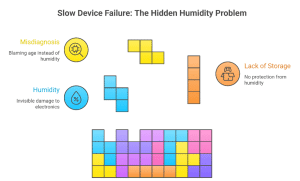
Sometimes, the real problem is something you can’t see.
And if you’re not using proper electronics storage or humidity control storage, your devices could be getting damaged right now…without you even noticing.
Why Humidity Is the Silent Enemy of Electronics Storage
Humidity is simply moisture in the air.
And electronics?
They hate moisture.
Even a small amount of humidity can slowly affect internal components.
This is why safe device storage and humidity control storage are critical for protecting electronics.
Because unlike physical damage…
Humidity damage is silent.
How Humidity Actually Damages Your Devices
Let’s break it down simply.
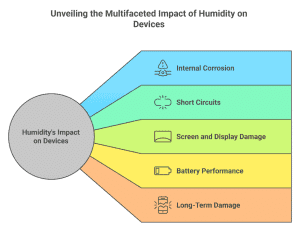 1. Moisture Causes Internal Corrosion
Inside every device are delicate circuits.
When moisture enters:
- metal components start corroding
- connections weaken
- performance drops
This is one of the biggest reasons electronics fail.
2. Short Circuits Become More Likely
Humidity increases the chances of:
- electrical interference
- short circuits
- sudden device failure
Even a small amount of moisture can create serious issues.
Humidity can affect screens by:
- causing internal fogging
- creating display issues
- reducing clarity over time
4. Battery Performance Gets Affected
Moisture exposure can:
- reduce battery life
- cause swelling
- impact charging efficiency
5. Long-Term Damage You Can’t Reverse
The biggest problem?
Humidity damage builds slowly.
By the time you notice it…
It’s already too late.
Where Most People Go Wrong with Electronics Storage
Here’s the common mistake.
People think:
“If it’s inside the house, it’s safe.”
But that’s not always true.
Especially in cities with:
- high humidity
- changing weather
- poor ventilation
Storing devices in cupboards, boxes, or storage rooms without humidity control storage can actually trap moisture.
Which makes things worse.
What Electronics Need: Stable Environment, Not Just Space
Electronics don’t just need storage.
They need the right environment.
That means:
- controlled humidity
- stable temperature
- minimal exposure to moisture
This is exactly what electronics storage with humidity control provides.
How to Prevent Humidity Damage (Simple but Effective)
Now let’s talk solutions.
1. Avoid Damp or Closed Storage Spaces
Never store electronics in:
- damp rooms
- basements
- unventilated cupboards
These spaces trap moisture.
If storing devices:
- wrap them properly
- use moisture-resistant materials
- avoid direct exposure
Don’t place electronics directly on floors.
Moisture tends to settle lower.
4. Use Humidity Control Storage for Long-Term Protection
This is the most effective solution.
With humidity control storage and safe device storage, your electronics are kept in:
- controlled environments
- stable conditions
- moisture-free spaces
This prevents long-term damage completely.
Who Needs Proper Electronics Storage the Most
You might think this doesn’t apply to you.
But it does if you:
- store extra devices
- keep old electronics
- run a business with equipment
- have expensive gadgets
- travel frequently
Because unused electronics are actually more vulnerable to humidity damage.
A Real Situation You Might Relate To
You stored your old laptop.
Kept it safely in a cupboard.
Didn’t use it for months.
Later, you tried to turn it on.
It worked… but not the same.
Slow. Unstable. Something felt off.
That’s not age.
That’s environment.
The Real Difference: Storing vs Protecting
Anyone can store electronics.
But protecting them?
That requires the right conditions.
That’s the difference between:
❌ normal storage
✅ safe device storage with humidity control
A Simple Question to Think About
You’ve spent money on your devices.
But have you thought about how you store them?
Because storage doesn’t just affect space.
It affects lifespan.
Before You Store Your Electronics, Read This
Can humidity damage electronics even when not in use?
Yes. Moisture can affect internal components even when devices are not being used.
What is humidity control storage?
It is storage that maintains controlled moisture levels to protect sensitive items like electronics.
Is normal storage safe for electronics?
Not always. Without humidity control, electronics can get damaged over time.
What devices need safe electronics storage?
Laptops, cameras, TVs, gaming consoles, and any sensitive electronic equipment.
How can I protect electronics long-term?
Using proper packaging and humidity control storage is the best solution.
Your Devices Deserve Protection…Not Just Storage
Electronics are not cheap.
And they don’t fail randomly.
They fail because of how they’re stored.
Get an instant quote in 60 seconds with Your Space
Call now: +91 8433925040
