
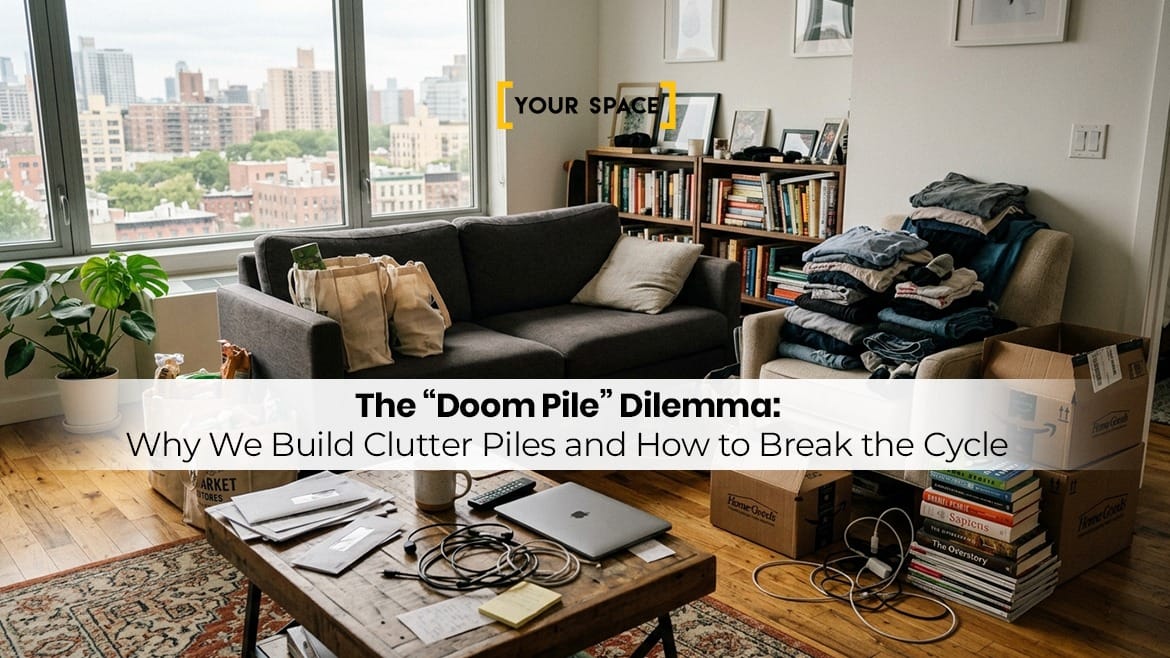
Everyone Has a Doom Pile, Even the Organized People
You know the spot.
That chair in the bedroom.
The corner near the dining table.
The shelf where random things quietly gather.
Clothes.
Receipts.
starts from here Bags.
Half-finished tasks.
At first, it’s temporary.
Then suddenly…
it becomes permanent.
That’s a doom pile.
And if you’ve ever looked at yours and thought:
“Why can’t I just deal with this?”
You’re not lazy.
You’re human.
Because clutter is rarely just about “mess.”
It’s usually about:
- delayed decisions
- mental overload
- emotional attachment
- exhaustion
That’s why clutter psychology and mental wellness are more connected than people realize.
Why Doom Piles Happen in the First Place
Most clutter doesn’t start intentionally.
Nobody wakes up thinking:
“Today I’ll create chaos.”
It usually starts with one thought:
“I’ll deal with it later.”
A shirt gets dropped on a chair.
A package stays unopened.
A document sits on the counter.
And because life keeps moving…
those tiny decisions pile up physically.
This is where clutter psychology becomes important.
Because doom piles are often symptoms of:
- stress
- burnout
- overwhelm
- decision fatigue
Not laziness.
The Hidden Mental Weight of Visual Clutter
Clutter does something strange to the brain.
Even when you stop consciously noticing it…
your mind still processes it.
Every pile quietly signals:
- unfinished tasks
- delayed decisions
- mental pressure
That’s why cluttered environments often create:
- anxiety
- reduced focus
- guilt
- mental exhaustion
This is one of the biggest reasons people feel “drained” at home without understanding why.
Why Some People Become Emotional Clutter Keepers
Not all clutter is practical.
Sometimes it’s emotional.
Old gifts.
College notes.
Broken electronics.
Clothes from years ago.
People don’t keep these because they’re useful.
They keep them because they represent:
- memories
- comfort
- identity
- fear of regret
This is a huge part of clutter psychology and emotional wellness.
Because letting go of objects can sometimes feel like letting go of moments.
The “I Might Need This Someday” Trap
This is one of the most common clutter patterns.
People keep things:
- just in case
- for backup
- for future versions of themselves
And individually?
Each item feels harmless.
But together…
they slowly consume space and mental energy.
This is where household storage and organized decluttering systems become healthier solutions than extreme minimalism.
Because the goal is not to own nothing.
The goal is to stop feeling overwhelmed by everything.
What Kind of Clutterer Are You?
Take this quick mental quiz.
The Sentimentalist
Keeps things because of emotional memories.
The Procrastinator
Delays organizing because it feels mentally exhausting.
The “Just in Case” Hoarder
Keeps items for unlikely future situations.
The Busy Survivor
Not messy — just overwhelmed and out of time.
The Hidden Piler
Looks organized… until cupboards are opened.
Most people are a mix of several.
And honestly?
That’s normal.
Why Traditional Decluttering Advice Often Fails
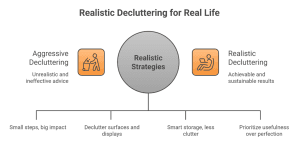
Most decluttering advice sounds aggressive.
“Throw everything away.”
“Own only essentials.”
“Be ruthless.”
But real life doesn’t work that way.
Especially when:
- people work long hours
- homes are small
- emotions are attached to belongings
This is why realistic declutter home strategies work better:
- organize gradually
- reduce visual overload
- use storage intentionally
- focus on functionality
Not perfection.
The 10-Minute Rule That Helps More Than Massive Cleaning Sessions
Most people avoid decluttering because it feels too big.
Too tiring.
Too emotional.
So instead of trying to “fix the whole house” …
try this:
Set a timer for 10 minutes.
That’s it.
Focus on:
- one chair
- one shelf
- one drawer
Small progress reduces overwhelm faster than giant cleaning marathons.
Why Organized Storage Helps Mental Wellness
This is important.
Storage is not about hiding clutter.
Good storage creates:
- breathing room
- visual calm
- easier routines
- reduced mental stress
That’s why household storage and space organization systems help people emotionally — not just physically.
Because when your environment feels calmer…
your mind often follows.
The Difference Between Messy and Mentally Exhausted
Here’s something people rarely say out loud.
Sometimes clutter is not a cleaning problem.
It’s an energy problem.
People don’t avoid organizing because they don’t care.
They avoid it because:
- they’re overwhelmed
- mentally tired
- emotionally overloaded
That perspective changes everything.
Because now the solution becomes gentler.
More realistic.
More human.
The Goal Isn’t a Perfect Home, It’s a Peaceful One
This is where people get stuck.
They think:
“If my house isn’t perfectly organized, I’ve failed.”
But that’s not the goal.
The real goal is:
- less stress
- easier mornings
- calmer spaces
- more mental clarity
That’s what healthy clutter management and mental wellness actually look like.
A Small Shift That Changes Everything
You don’t need to organize your entire life today.
You just need to make one corner lighter.
One shelf calmer.
One pile smaller.
Because sometimes the fastest way to feel mentally lighter…
is to reduce what your eyes constantly carry.
Before You Start Decluttering, Read This
What is a doom pile?
A doom pile is a collection of clutter created by delayed decisions, overwhelm, or emotional attachment to belongings.
Why does clutter create anxiety?
Visual clutter increases mental overload and constantly reminds the brain of unfinished tasks.
Is clutter linked to mental wellness?
Yes. Clutter can affect stress levels, focus, emotional comfort, and overall mental well-being.
What is the easiest way to start decluttering?
Start small. Focus on one area for 10 minutes instead of trying to clean the entire home at once.
Does organized storage help reduce stress?
Yes. Organized storage creates calmer environments and reduces visual and mental overload.
Maybe the Problem Isn’t Your Home, It’s the Pressure Inside It
You don’t need a perfectly aesthetic apartment.
You need a space that feels lighter to live in.
Try the 10-minute declutter challenge today: Get an instant quote
Call now: +91 8433925040
