

Diwali is over. The lights are coming down, the last box of sweets is nearly empty, the guests have gone home, the new clothes have been worn, and the house is slowly returning to its usual rhythm. And then you notice something: Diwali may be over, but your house hasn’t recovered yet.
There are boxes in the corner, a bundle of fairy lights that somehow became one giant knot, diyas waiting to be cleaned and packed, and gift boxes that are far too beautiful to throw away. A mattress that was brought out for guests never quite made it back. Festive clothes have taken over one section of the wardrobe. And somewhere in the house is a mysterious bag that someone confidently labelled “Diwali stuff. Sort later.” Later, of course, has a way of becoming next year.
This is the part of the festival nobody really talks about. We spend weeks preparing for Diwali — cleaning the house, decorating, shopping and making space for guests. But once the celebrations are over, we’re left with a surprisingly simple question: what do we actually do with everything now?
That is where post-Diwali cleaning, Diwali decluttering and smart Diwali storage come together. Not everything needs to be thrown away, and not everything needs to stay in your living room either. Sometimes the answer is simply to give things a proper place until you need them again. And that brings us to the seven things that somehow survive every Diwali.
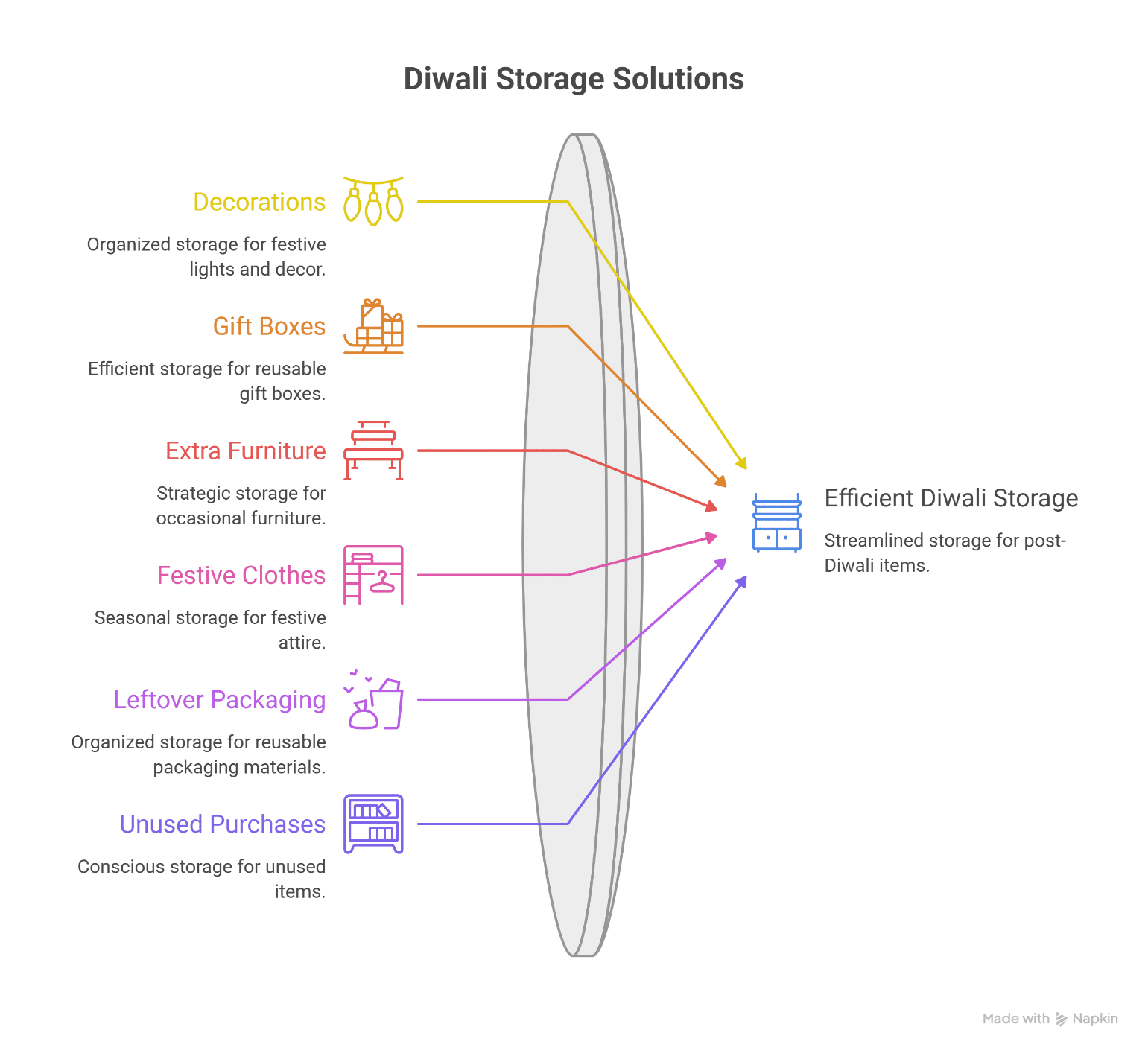
1. The Decorations
Let’s start with the obvious survivors: the fairy lights, the diyas, the lanterns, the torans, the artificial flowers, the rangoli materials, and the decorative pieces you bought because they looked perfect against the wall. During Diwali, every one of these things has a job. A few days later, they suddenly need a home — and this is where Diwali decoration storage becomes more important than it first appears.
The fairy lights
Every year, someone says, “Just put them in this box, we’ll sort them next year.” You already know how this story ends: next Diwali, you open the box and find what appears to be a small electrical jungle. One string works, one doesn’t, nobody remembers which adapter belongs to which light, and somehow three strings have tied themselves together. A little organisation after Diwali can save a surprising amount of frustration next year — wind lights carefully, keep their accessories together and label the container. Future-you has enough to do when Diwali arrives.
Diyas, lanterns and decorative pieces
Not every decoration can simply be tossed into a bag. Some diyas may be fragile, some lanterns can bend or tear, and glass decorative pieces can chip. Certain items may also carry sentimental value because they’ve been part of family celebrations for years. Clean reusable items before putting them away, make sure anything that could retain moisture is properly dry, and separate delicate pieces from sturdier decorations. Good storage for Diwali decorations isn’t about hiding everything until next year, it’s about making sure the things you want to reuse actually survive the journey there.
Rangoli materials and artificial flowers
Rangoli stencils, reusable decorative pieces, artificial flowers and festive accessories are another category that tends to get mixed together. Give them a dedicated box and label it, and next year, instead of opening five unrelated containers looking for one decoration, you’ll know exactly where to look. That’s the beauty of simple Diwali storage ideas — they save time twice, once when you pack and again when you unpack.
2. The Gift Boxes
Now we reach one of the strangest post-Diwali survivors: the gift box. You open the Diwali gift, take out what’s inside, and then look at the box. It’s beautiful, it has a nice lid, the design is too good, the material is too sturdy — so naturally, “we shouldn’t throw this away.” Fair enough. One box becomes three, three become seven, and seven become an entire collection of boxes sitting on top of the wardrobe.
This is where Diwali gift storage can quietly turn into another household storage problem. The question isn’t whether a beautiful gift box could be useful someday, almost anything could be useful someday. The better question is: will you realistically use it? If you have a genuine use for the boxes, keep them together. If you’re keeping them only because throwing them away feels wrong, it’s worth reconsidering. And if you’re keeping a large collection for future gifting, give those boxes one dedicated home instead of allowing them to migrate around the house.
3. The Extra Furniture
Diwali is one of those times when the house suddenly needs to accommodate more people than usual. Family arrives, friends drop by, and dinner becomes a bigger event, so the extra chairs, folding tables, mattresses and stools that normally sit quietly somewhere in storage suddenly become extremely useful. Then the festival ends, the guests leave, and the furniture is still there. The extra chair is now in the bedroom, the folding table is behind the sofa, the mattress is leaning against a wall, and somebody says, “we’ll put it back tomorrow.”
This is where furniture storage can make a real difference. If a piece of furniture is useful but only needed occasionally, getting rid of it isn’t necessarily the answer, but neither is allowing it to occupy valuable everyday living space for eleven months. The same applies to spare mattresses, folding chairs and tables. If you use them during festivals, family gatherings or occasional events, think about when you need them rather than assuming they need to be physically present all year.
The guest-room problem
There is another familiar Diwali situation: the guest room is supposed to be ready for guests, but before Diwali, it becomes the room where everything gets temporarily placed boxes, suitcases, decorations, old furniture, extra bedding. Then the guests arrive, and suddenly someone must perform a last-minute archaeological excavation. A guest room works much better when it’s available for guests. Rarely used belongings can have a different home that’s one of the simplest principles behind practical household storage.
4. The Festive Clothes
Then there’s the wardrobe. Diwali shopping is done — the new sarees are here, the lehengas are here, the kurtas are here, the sherwanis are here, the occasion wear has arrived. And your wardrobe is quietly asking, “where exactly do you expect me to put all this?”
The problem isn’t necessarily buying new clothes. It’s that festive clothing often has a completely different usage pattern from everyday clothing. You might wear your favourite Diwali outfit once or twice a year, while your everyday clothes need to be accessible every week. That’s where festive clothes storage and seasonal storage become useful concepts. Occasion wear can be organised separately from everyday clothing; before long-term storage, make sure garments are clean and completely dry, and protect delicate clothing appropriately. The goal isn’t to bury your favourite outfit somewhere you’ll never find it — it’s to stop something you wear twice a year from competing with something you wear twice a week.
5. The Leftover Packaging
This one sneak up on you. You don’t plan to accumulate packaging — it just happens. Gift bags, wrapping paper, ribbons, decorative boxes, shopping bags, cartons, festive sleeves, online delivery packaging. A few weeks after Diwali, your home can have an impressive collection of things whose main purpose appears to be “maybe we’ll need this later.”
Some packaging is genuinely worth keeping, reusable gift bags can come in handy, and good-quality boxes can be useful for future gifting. But there is a point where storage becomes more expensive, in terms of space, than the thing you’re storing. So sort it: keep what you genuinely expect to reuse, recycle what can be recycled, and let go of what has no realistic purpose. Then give the things you’re keeping one dedicated place.
The business version of the packaging problem
For businesses, this problem gets much bigger. A household might have one cupboard of festive packaging; a corporate gifting company could have cartons of it. An e-commerce business may need additional boxes, labels, tapes, wrapping materials and promotional packaging during the festive period. The products themselves aren’t the only inventory, the materials required to sell and ship those products are inventory too. This is where festive inventory storage, business storage and seasonal inventory storage become relevant. A business shouldn’t have to turn its meeting room into a packaging warehouse simply because festive demand increased temporarily.
6. The Unused Purchases
Every Diwali has them, the things we bought because “it was a great deal,” or “we’ll definitely use this,” or “it’ll look perfect somewhere.” And then we get home, the thing gets used once (or never), and now it’s part of the household.
This is the category where post-Diwali decluttering becomes important. Before putting an unused purchase into storage, ask yourself: would I buy this again today? If the answer is no, perhaps it doesn’t need to stay. If you genuinely expect to use it, keep it. If someone else would benefit from it more, consider giving it away. And if it’s valuable but simply not needed right now, storage may be reasonable. The key distinction is this: don’t use storage to postpone every decision use storage for things you’ve consciously decided to keep.
7. The Things Everyone Said They’d Organise “Tomorrow”
And now we arrive at the most dangerous category of all: the things nobody has decided what to do with. The mystery boxes, the unidentified bags, the decorations without labels, the clothes waiting to be sorted, the gift packaging someone plans to reuse, the old household items that are “still good,” and, of course, the famous box marked “Diwali miscellaneous.” This is how temporary storage becomes permanent clutter.
The solution doesn’t have to be complicated. Give yourself one post-Diwali reset day. Open the boxes, sort the belongings, decide what stays, decide what goes, decide what gets donated, decide what can be sold, and decide what needs proper storage. Then label what remains because if you can’t remember what’s inside the box now, there’s a very good chance you won’t remember six months from now.
What Should You Keep, Donate, Sell or Store?
This is where a little honesty helps. Not everything needs to be stored, and not everything needs to be thrown away. Try dividing your post-Diwali belongings into four simple groups:
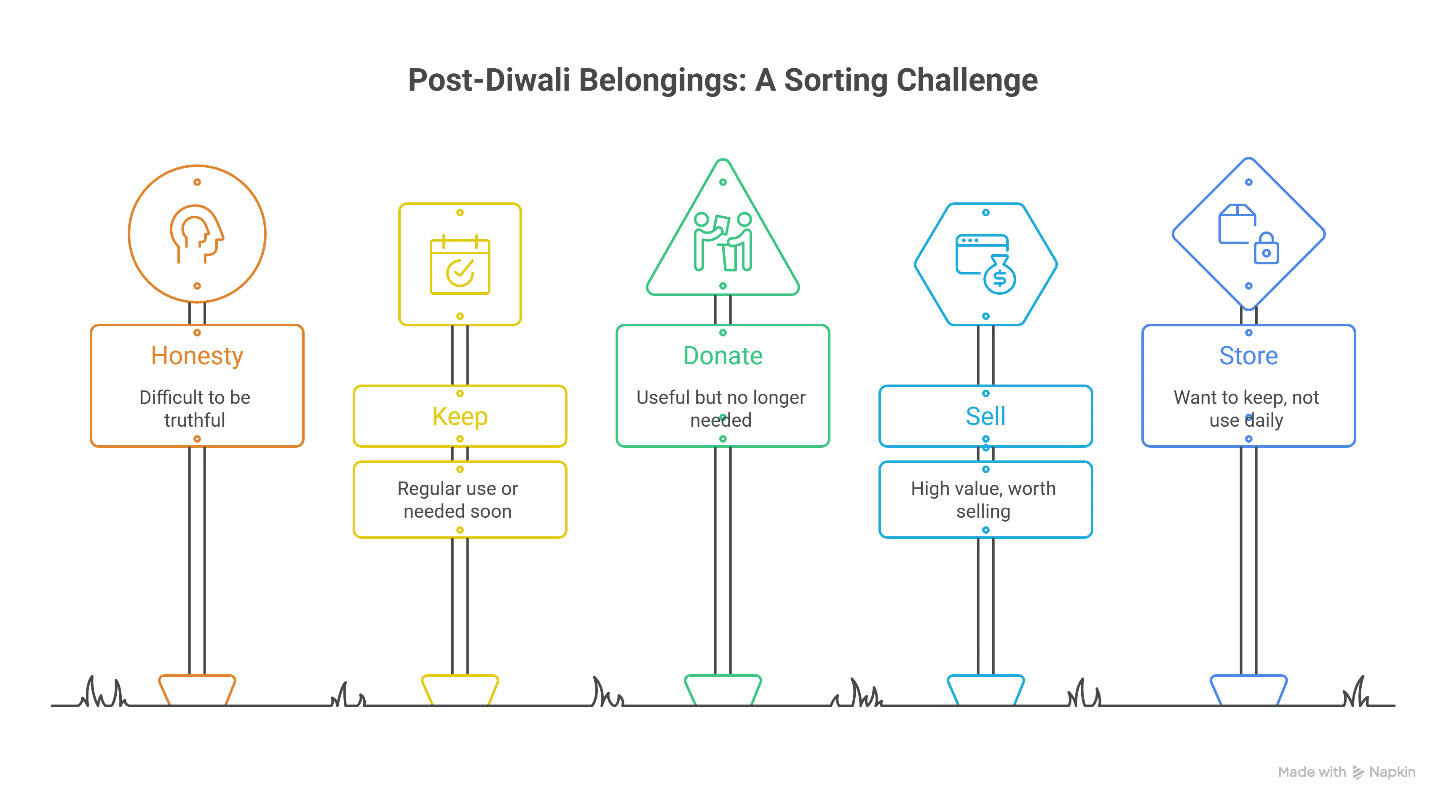
- Keep — things you use regularly or expect to need soon
- Donate — things that are useful but no longer serve a purpose in your household
- Sell — items with enough value to justify selling rather than storing
- Store — things you genuinely want to keep but don’t need occupying your everyday space
That final category is important. Sometimes the correct answer isn’t “get rid of it”, it’s “keep it, just somewhere else.”
The Post-Diwali Storage Reset
Once you’ve sorted everything, think about how often you’ll use it:
- Everyday belongings should remain easy to access
- Seasonal decorations can be grouped together
- Occasion wear can be organised separately
- Extra furniture can be kept out of everyday living areas
- Fragile decorations should be protected
- Important belongings should be clearly labelled
And if the home simply doesn’t have enough space for things, you genuinely want to keep, external personal storage or household storage can be another option. The principle is simple: your home doesn’t have to physically hold everything you always own.
What About Leftover Diwali Inventory?
There’s a second version of the post-Diwali problem, and this one belongs to businesses. The festive orders have slowed and the campaign is finished, but the business still has leftover products, Diwali gift hampers, packaging materials, promotional material, seasonal merchandise, cartons and excess stock.
For an e-commerce seller, retailer or corporate gifting company, these things can occupy valuable working space. This is where Diwali inventory storage and commercial storage can help businesses separate everyday operations from seasonal stock. A company may not need permanent additional premises — it may simply need additional capacity during a particular season. For businesses with more complex fulfilment requirements, 3PL storage can also be part of the conversation, depending on the services required. The objective is straightforward: let your office remain an office and let your inventory have its own space.
Your Home Doesn’t Need to Store Your Entire Diwali
This might be the most useful way to look at the whole problem. You don’t have to throw away decorations you love. You don’t have to get rid of furniture you’ll use again. You don’t have to donate festive clothes simply because you don’t wear them every week. And you don’t have to keep every box just because it looks nice. You simply need to decide what deserves your everyday space — because space is valuable, and the things you use every day should not have to compete with things you use once a year. That’s the real purpose of festive storage: not hiding your belongings, not encouraging you to keep everything, just creating a better relationship between what you own and where you live.
Final Thoughts
Diwali may last a few days, but some things have an impressive ability to survive it: the decorations, the gift boxes, the extra furniture, the festive clothes, the packaging, the unused purchases, and, of course, the things everyone promised to organise “tomorrow.” Don’t let tomorrow become next Diwali.
Look around your home. Ask what you genuinely want to keep, what you no longer need, and what should be easier to access. Ask what doesn’t really need to occupy space in your home for the next eleven months. Because the best feeling after Diwali isn’t simply “the house is clean” — it’s “everything has a place now.” And sometimes, that place doesn’t have to be inside your home.
Frequently Asked Questions
What should I do with Diwali decorations after Diwali?
Clean and dry reusable decorations, separate fragile items, organise similar pieces together and label them. Items that aren’t needed throughout the year can also be considered for suitable seasonal or household storage.
Where should I store Diwali decorations?
Diwali decorations can be stored in a dedicated cupboard, storage area or external storage facility, depending on their quantity and your available space.
How should I store Diwali lights?
Untangle and wind lights carefully, keep their accessories together and place them in a clearly labelled container. Avoid mixing multiple light strings and electrical accessories without organisation.
What should I do with leftover Diwali gift boxes?
Keep boxes that you realistically expect to reuse and recycle or let go of excess packaging. If you’re retaining gift boxes for future use, store them together rather than allowing them to occupy multiple areas of the house.
How can I create space after Diwali?
Sort your belongings into four categories: keep, donate, sell and store. Seasonal decorations, extra furniture and other occasional-use belongings can potentially be moved into appropriate storage.
How should I store Diwali clothes?
Clean and completely dry festive clothing before storing it. Keep occasion wear organised separately from everyday clothing and use appropriate protection for delicate garments.
Where can I store extra furniture after Diwali?
If furniture is useful but rarely required, suitable furniture or household storage can help keep it outside your everyday living space while retaining it for future use.
What is post-Diwali cleaning?
Post-Diwali cleaning involves returning your home to its normal arrangement after the festival, including organising decorations, gifts, clothing, furniture, packaging and other belongings associated with the celebrations.
Can businesses store leftover Diwali inventory?
Yes. Businesses can consider inventory or commercial storage for seasonal products, gift hampers, packaging materials, promotional items and other festive stock that isn’t required in their everyday workspace.
What is the difference between decluttering and storage?
Decluttering is the process of deciding what you no longer need. Storage is about finding a suitable place for things you’ve decided to keep.
Is Diwali storage only for decorations?
No. Diwali storage can include decorations, festive clothing, furniture, gifts, packaging, household belongings and business inventory.
Diwali Is Over. Your Storage Problem Doesn’t Have to Last Until Next Diwali.
The lights are coming down. The guests have gone home. The sweets are disappearing. Now it’s time to give everything else a proper place.
If you’re left with Diwali decorations, festive clothes, extra furniture, gift boxes, household belongings or seasonal business inventory that you want to keep but don’t need occupying your everyday space, Your Space Doctor can help you explore a practical storage solution.
With storage solutions across Mumbai, Pune and Bengaluru, you can move occasional-use belongings out of your everyday space while keeping them available for when you need them again.
📞 Call +91 8433925040 to discuss your storage requirements.
Keep the memories. Keep what matters. Just don’t let it take over your home..
