

An aircraft can weigh hundreds of tonnes, travel across continents and carry hundreds of passengers. But sometimes, keeping its maintenance schedule on track comes down to finding one surprisingly small component. A fastener. A valve. A sensor. A replacement part that looks almost identical to the one sitting three shelves away.
And somewhere in an aviation warehouse, someone is asking the question nobody wants to hear during a busy maintenance shift:
“We have the part in stock, right? So where is it?”
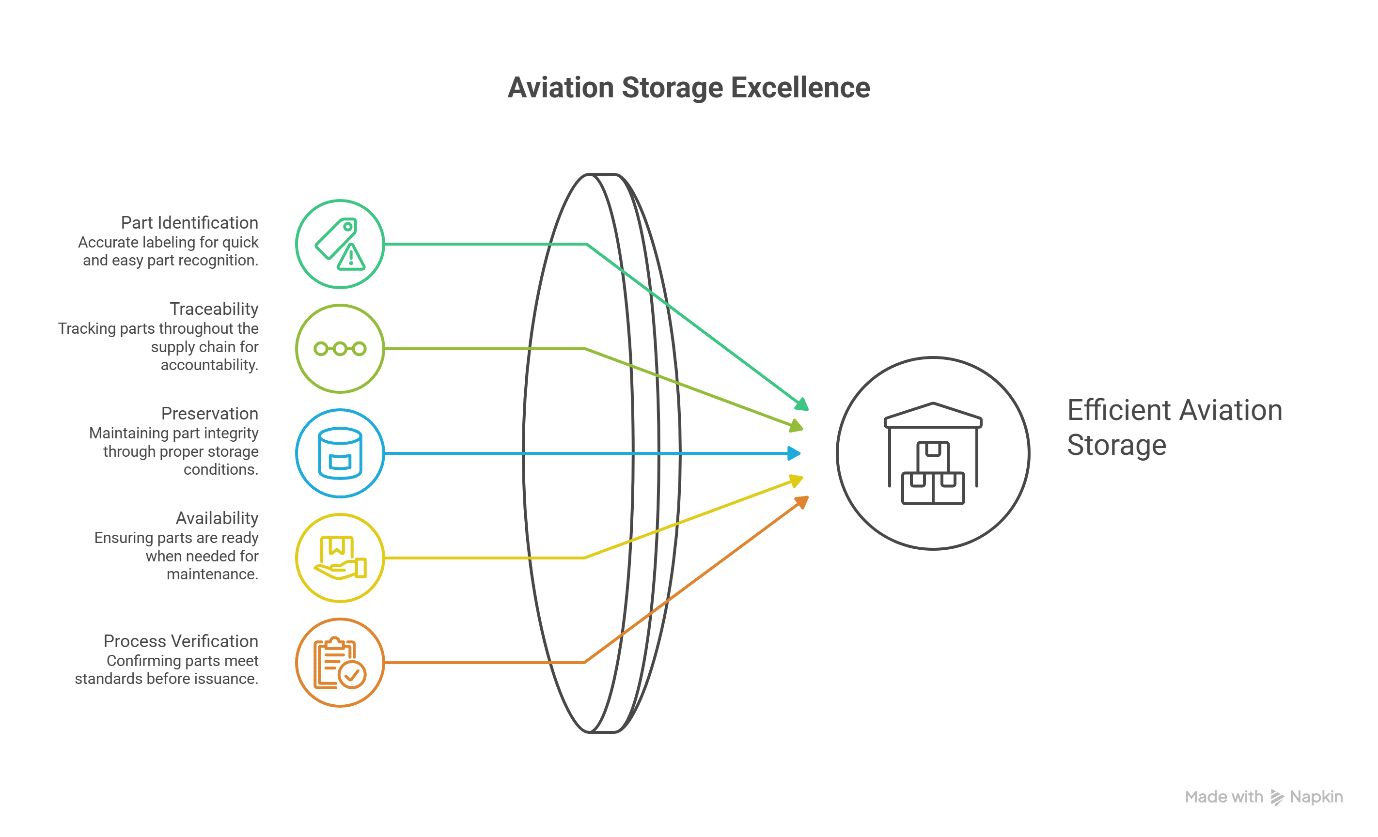
In aviation, inventory isn’t simply about counting boxes and filling shelves. Parts must be identifiable, traceable, properly preserved and available when required. A disorganised storage process can create delays, unnecessary handling and headaches for teams already working to demanding schedules.
For airlines, aircraft maintenance, repair and overhaul (MRO) providers, and aviation parts distributors, the challenge is bigger than finding room for inventory. It’s about making sure the right part can be located, verified and issued through the correct process. And with thousands of components, multiple part numbers and different storage requirements, that’s a serious organisational task.
1.Why Is Storing Aircraft Parts So Complicated?
At first glance, a warehouse is a warehouse. You receive goods, organise them, record them and retrieve them when needed. But aircraft spare parts come with requirements that make the process considerably more specialised.
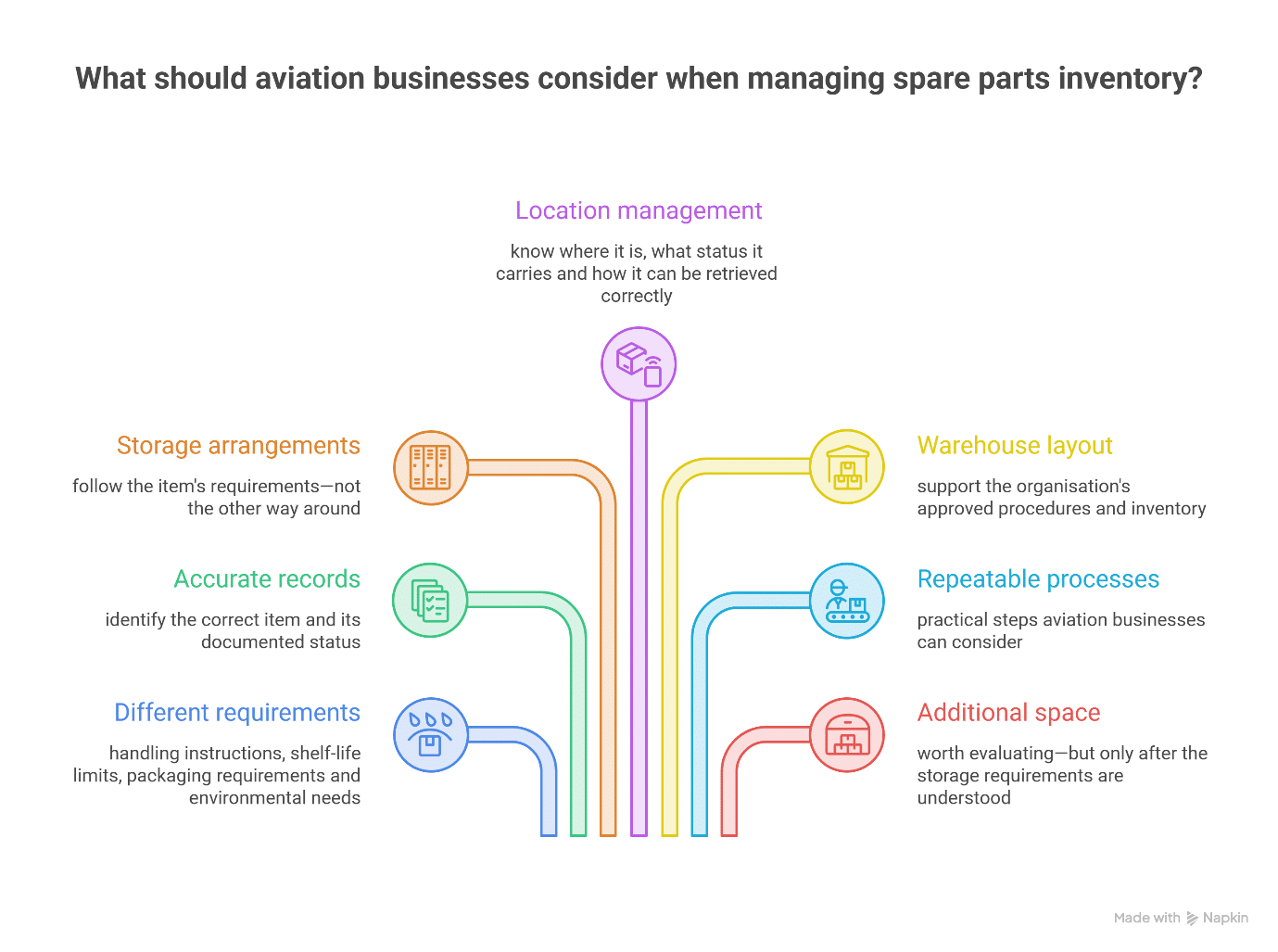
Different components can have different handling instructions, shelf-life limits, packaging requirements and environmental needs. Some items may need protection against moisture or corrosion. Others may require controlled conditions or specific preservation procedures.
Then there’s traceability. A component may need supporting documentation identifying what it is, where it came from, and whether it is eligible for its intended use. A label alone doesn’t establish that a component is approved for installation. This means an aviation inventory team must manage more than physical space. It must also manage information, documentation, condition and status.
Small components, big organisational demands
Imagine two components that look almost identical but have different part numbers or applicability. If they’re incorrectly labelled, mixed together or recorded against the wrong inventory entry, someone may spend valuable time investigating the discrepancy.
The solution isn’t simply to add more shelves. It’s to create a system where each component has a clear identity, a documented location and a controlled process for receiving, storing and issuing it.
2.The Real Challenge: Knowing Exactly What You Have
Every business wants an accurate inventory. Aviation businesses have particularly strong reasons to take it seriously. An inventory record should help the team answer essential questions: What is the item? How many are available? Where is it stored? What is its condition and status? Is its documentation complete? Are there any restrictions on its use?
If those answers live in different spreadsheets, handwritten notes and someone’s memory, problems become much more likely. And relying on one employee who knows where everything is isn’t a long-term inventory strategy. It’s a very stressful single point of failure.
Build a clear inventory record
Depending on the organisation’s systems and applicable requirements, useful inventory fields may include the part number and component description; the serial or batch number, where applicable; the quantity and physical storage location; the receipt date and supplier details; the condition and inventory status; any relevant shelf-life or inspection information; and the required supporting documentation.
Not every field applies to every item. The record should reflect the component type and the organisation’s approved procedures. The objective is straightforward: when an authorised team member searches for a part, the system should help them identify the correct item and its documented status without turning the search into a warehouse treasure hunt.
3.One Warehouse, Different Storage Requirements
Here’s where things get interesting. Aviation inventory isn’t one giant collection of interchangeable boxes. Different parts and supplies may require different storage arrangements. Some items may be suitable for conventional shelving or bins. Others may need protective packaging, special handling, controlled environmental conditions or segregation. The storage method must follow the item’s requirements—not the other way around.
Components that need protection
Metal components can be vulnerable to corrosion if their preservation requirements aren’t followed. Sensitive items may require particular packaging or environmental controls. Storage staff need to understand the applicable handling and preservation instructions rather than assume that a clean-looking shelf is sufficient.
Parts with shelf-life restrictions
Certain materials and components may have defined shelf lives or other time-related controls. These need appropriate records, monitoring and procedures for managing expiry or inspection requirements. A carton being physically present doesn’t automatically mean its contents are suitable for use.
High-value and controlled inventory
Some components may require restricted access, additional documentation or more rigorous tracking. Their storage arrangements should reflect the organisation’s security, traceability and regulatory obligations.
General aviation supplies
Not everything used by an aviation business is an aircraft component. Packaging materials, office supplies, uniforms, promotional items and certain non-sensitive operational equipment may have different storage needs from safety-critical parts. Separating these categories can help businesses plan their space more effectively—provided the storage arrangement is suitable for each item.
4.When a Missing Part Becomes a Maintenance Headache
Let’s say a maintenance team needs a particular component. The inventory system says it’s available. The team heads to the recorded location, but the item isn’t there. Someone checks another shelf. Another employee searches a nearby bin. A stock record is reviewed. Eventually, the team discovers that the part was moved but its location wasn’t updated.
The part existed all along. The problem was the process used to manage it. This kind of mismatch illustrates why inventory accuracy matters. Poorly controlled locations can lead to unnecessary searching, repeated handling, inaccurate stock records and delays while discrepancies are investigated. Depending on the circumstances, the team may need to source an alternative or revise its work plan.
How location management helps
A structured location system gives each storage position a unique identifier. Inventory records are updated when items are received, moved, counted or issued. Barcode or other scanning systems can support this process, where appropriate, by reducing manual entry and making stock movements easier to record.
The technology doesn’t have to be complicated to be useful. What matters is that the process is consistently followed and that the records reflect the physical inventory. The goal is not merely to know that a part exists. It’s to know where it is, what status it carries and how it can be retrieved correctly.
5.Why Aviation Warehouses Need More Than Extra Shelves
When inventory grows, the obvious reaction is to find more space. But adding shelves without reviewing the storage process can simply create a larger version of the same problem. A well-planned aviation warehouse needs to consider how items move through the facility—from receipt and identification to storage, inspection, picking and dispatch.
Organise around the workflow
A practical layout should support the organisation’s approved procedures and the characteristics of its inventory. Receiving areas need space for incoming goods and documentation checks. Storage locations need clear identification. Items awaiting inspection, review or other action should be managed according to defined status controls. Picking and dispatch processes should help staff identify and verify the correct items before release.
The precise layout depends on the business, component types, volume and applicable requirements. There is no single warehouse design that suits every aviation operation.
Don’t let temporary storage become permanent confusion
During busy periods, teams may place incoming cartons wherever space is available. That can work for a short time—but only if the items remain identified, their status is controlled and the location is recorded. Otherwise, a temporary solution becomes a permanent mystery.
If the warehouse regularly runs out of room, review whether the issue is genuinely insufficient capacity, inefficient layout, excess stock, slow-moving inventory or a combination of factors. The answer may involve additional storage, better inventory planning or both.
6.How to Manage Aviation Spare Parts Inventory More Effectively
Good inventory management is built on repeatable processes, not heroic last-minute searches. Here are practical steps aviation businesses can consider, subject to their own approved procedures and requirements.
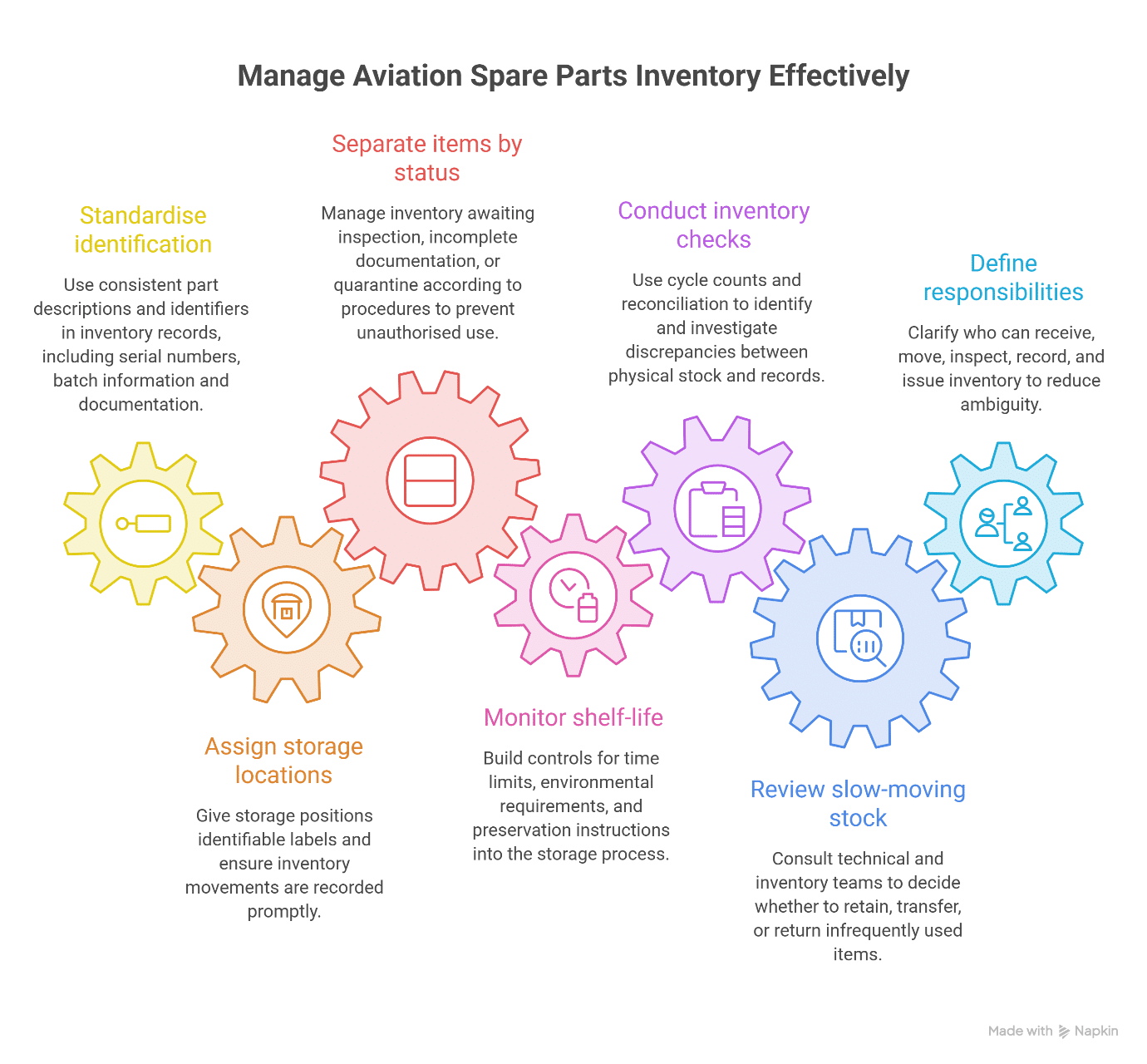
Step 1: Standardise identification. Use consistent part descriptions and identifiers in inventory records. Where applicable, record serial numbers, batch information and supporting documentation.
Step 2: Assign clear storage locations. Give storage positions identifiable labels and ensure inventory movements are recorded promptly.
Step 3: Separate items by status. Inventory awaiting inspection, items with incomplete documentation, quarantined stock and inventory cleared for a defined purpose should be managed in accordance with applicable procedures. Physical and system controls should prevent an item from being treated as available for use when it has not met the relevant requirements.
Step 4: Monitor shelf-life and preservation requirements. Where items have time limits, environmental requirements or preservation instructions, build those controls into the storage and inventory process.
Step 5: Conduct regular inventory checks. Cycle counts and other reconciliation procedures can help identify discrepancies between physical stock and recorded quantities. Investigate differences rather than simply adjusting numbers to make the records match.
Step 6: Review slow-moving stock. Some inventory is essential despite infrequent use. Other items may no longer match current requirements. Review stock with the appropriate technical and inventory teams before deciding whether it should be retained, transferred, returned or otherwise managed.
Step 7: Define responsibilities. Make it clear who can receive, move, inspect, record and issue each category of inventory. Clear responsibilities reduce ambiguity and make it easier to investigate discrepancies.
7.Should Aviation Businesses Use Additional Storage Space?
Sometimes, the problem isn’t the inventory system. It’s that the business has outgrown its available space. An aviation parts distributor may expand its product range. An MRO provider may need additional room for eligible inventory. A supplier may experience temporary volume increases. An aviation business may also need to relocate its office or reorganise its existing facility. In these situations, additional space can be worth evaluating—but only after the storage requirements are understood.
What should businesses consider before outsourcing storage?
Start with the type of items involved. Are they ordinary business supplies, non-sensitive equipment or components that require specialised aviation storage controls? Next, consider the required environmental conditions, security, traceability, documentation, access frequency and handling procedures. Finally, verify whether the proposed facility and its operating processes meet the requirements applicable to the inventory.
A general storage warehouse should not be assumed suitable for aircraft components merely because it has spare capacity. For safety-critical or regulated inventory, businesses should use facilities and processes appropriately qualified for the relevant requirements. For suitable non-sensitive materials—such as office equipment, packaging supplies, promotional materials and certain general business belongings—conventional business storage may offer a way to free up operational space.
8.The Business Case for Better Storage and Inventory Control
Aviation inventory management isn’t just a warehouse concern. It affects the way different teams work together. Maintenance teams need accurate information about component availability and status. Procurement teams need reliable stock records to support purchasing decisions. Warehouse staff need clear processes for handling and locating items. Management needs visibility into inventory levels and storage costs.
When these functions work from consistent records, businesses are better positioned to plan their operations. Better organisation can help reduce unnecessary searching, improve inventory visibility, support stock reconciliation and make more effective use of storage capacity. It can also help businesses identify where money is tied up in inventory and whether their current space is being used efficiently.
The exact financial and operational benefits depend on the business’s existing processes, systems and inventory profile. But the underlying principle remains the same: inventory should be managed deliberately, not simply accommodated wherever a spare shelf appears.
9.Frequently Asked Questions About Aircraft Spare Parts Storage
Why is aircraft spare parts storage different from ordinary warehousing?
Aircraft components may have specific traceability, documentation, preservation, shelf-life, environmental and handling requirements. Storage arrangements must reflect the relevant requirements for each item.
How can aviation businesses reduce inventory errors?
Consistent item identification, clear location labels, timely movement records, regular stock checks and defined responsibilities can help reduce discrepancies.
Do all aircraft spare parts require climate-controlled storage?
No single storage condition applies to every component. Requirements depend on the item’s characteristics, manufacturer instructions and applicable procedures. Businesses should verify the requirements for each item rather than assume one environment suits everything.
What is aviation inventory traceability?
Traceability is the ability to track an item’s identity and relevant history through records. Depending on the component and applicable rules, this may include part and serial numbers, origin, documentation, status and movement history.
Can aviation businesses use general-purpose storage warehouses?
Some non-sensitive business materials may be suitable for general-purpose storage. Aircraft components that require specialised aviation controls should only be stored through arrangements that meet their applicable technical, regulatory and handling requirements.
How can a business tell whether it needs more warehouse space?
Review inventory volume, storage density, access frequency, workflow, stock accuracy and the space required for receiving and dispatch. This helps distinguish a genuine capacity problem from a layout or inventory-management issue.
10.MAKE SPACE WORK HARDER FOR YOUR BUSINESS
Thousands of components. Different requirements. Records that need to stay accurate. And maintenance teams that need the right information at the right time. Aviation inventory is a reminder that good storage is about more than finding room for things. It’s about having a clear plan for what is stored, where it belongs and how it is managed.
For suitable business materials, equipment and general inventory, Your Space Doctor offers storage solutions for businesses looking to manage their space more effectively. Contact the team to discuss your requirements and confirm whether the available services are appropriate for your items and location.
Give your business more room to operate—and your inventory a better-organised plan.
Call Your Space Doctor at +91 8433925040.
