
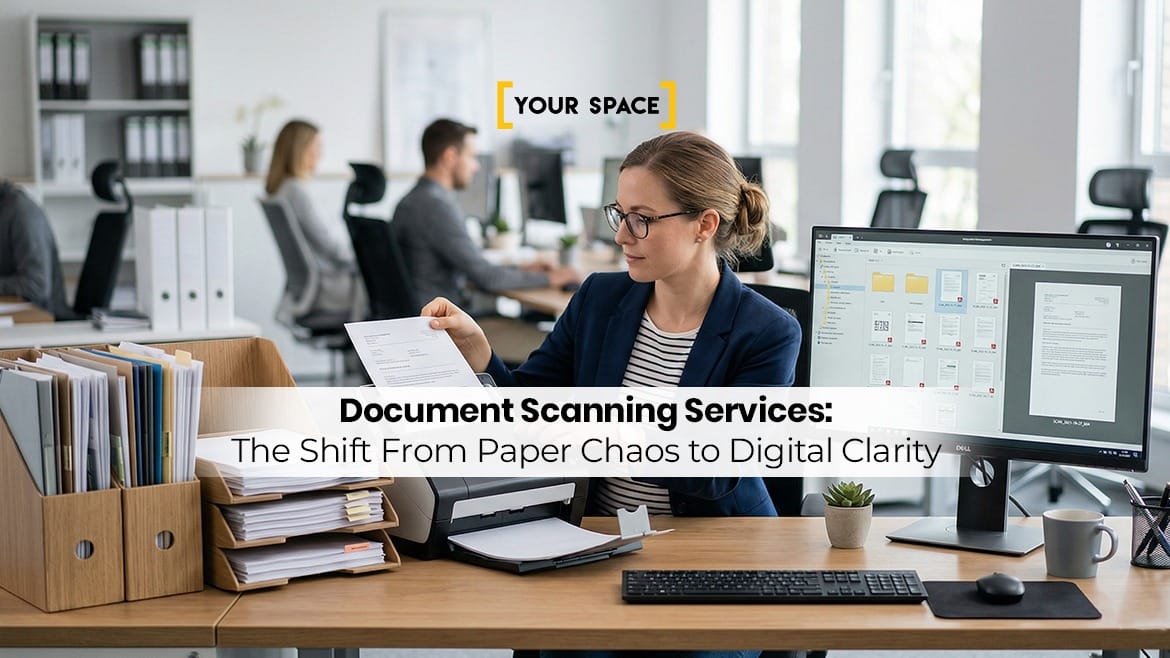
The Problem Nobody Talks About…Paper Is Quietly Taking Over
Walk into most offices.
Not the fancy meeting rooms.
Not the reception.
Go to the back.
You’ll find it.
Stacks of files.
Old records.
Boxes filled with documents nobody has touched in years.
Invoices.
Contracts.
Reports.
Medical files.
Legal papers.
All important.
All necessary.
But also… completely unmanageable.
Because the real problem isn’t just storage.
It’s access.
Try finding one document from five years ago.
You’ll spend hours.
Maybe days.
That’s when businesses start asking a simple question:
Why are we still managing everything on paper?
What Document Scanning Services Actually Solve
At first glance, scanning documents sounds simple.
Just scan and store, right?
Not really.
Because businesses don’t just need scanned files.
They need:
• structured data
• searchable records
• organized systems
• fast access
That’s where document scanning services become a real solution…just a process.
According to your service capabilities, scanning isn’t limited to basic documents. It includes:
• invoices
• contracts
• paper records
• medical records
• business documentation
This turns physical paperwork into something usable.
The Real Shift: From Storage to Accessibility
Paper files sit.
Digital files work.
That’s the difference.
When documents are digitized:
• they can be accessed instantly
• they can be shared easily
• they can be stored securely
• they don’t take physical space
Businesses don’t just save space.
They gain control.
This is why document scanning is less about storage…
and more about how information flows inside a company.
Not All Documents Are the Same…And That Matters
One of the biggest challenges in digitization is variety.
Different documents need different approaches.
Your scanning services cover multiple formats using specialized equipment such as:
• flatbed scanners for delicate or flat documents
• sheetfed scanners for bulk document processing
• photo scanners for preserving image quality
• document scanners for text-heavy files
• handheld scanners for irregular items
This matters because businesses don’t deal with one type of document.
They deal with everything.
And each one needs to be handled differently.
What Happens After Scanning? (This Is Where It Gets Powerful)
Scanning alone is not enough.
If documents are not organized, you still have a problem — just in digital form.
That’s where two important processes come in.
OCR: Turning Images into Usable Data
OCR (Optical Character Recognition) converts scanned files into searchable and editable text.
This means:
• you can search keywords
• you can copy data
• you can retrieve files instantly
Instead of scrolling through PDFs…
you simply type and find.
OCR helps businesses unlock the real value of their documents .
Document Indexing and Metadata Tagging
Imagine having thousands of files.
Now imagine finding the exact one in seconds.
That’s what indexing does.
Documents are tagged with:
• names
• categories
• dates
• identifiers
This creates a structured system where retrieval becomes effortless.
Large Format Documents: The Overlooked Challenge
Not all documents fit into a scanner.
Some are:
• blueprints
• architectural drawings
• maps
• engineering diagrams
These are critical documents.
And they’re often difficult to store and manage.
Large format scanning ensures these oversized documents are:
• digitized accurately
• preserved in high resolution
• easily shareable
This is especially useful for industries like construction, engineering, and design.
Why Businesses Are Moving Away from Paper
This shift is not about trends.
It’s about practicality.
Paper-based systems create problems:
• slow retrieval
• storage costs
• risk of damage
• duplication issues
Digital systems solve them.
And that’s why more businesses are choosing document scanning services as a long-term operational solution.
A Real Situation Every Business Faces
Let’s say a client asks for a document.
From 4 years ago.
You know it exists.
But where?
In which file?
In which box?
In which cabinet?
Now imagine the same situation with digitized records.
You type a keyword.
You find it in seconds.
That’s not convenience.
That’s efficiency.
The Hidden Benefit: Better Decision Making
When documents are accessible:
• teams work faster
• decisions are quicker
• errors reduce
Information flows better.
And when information flows better, businesses perform better.
Document Scanning Is Not About Technology…It’s About Control
Most people think scanning is a tech upgrade.
It’s not.
It’s a control upgrade.
You move from:
• searching → finding
• storing → accessing
• managing → organizing
That’s the real shift.
Before You Switch to Document Scanning Services, Read This
What are document scanning services used for?
They help convert physical documents into digital formats for easier storage, access, and management.
What types of documents can be scanned?
Paper records, invoices, contracts, medical records, blueprints, and more can be digitized.
What is OCR in document scanning?
OCR converts scanned images into searchable and editable text, improving document usability.
Can large documents like maps and drawings be scanned?
Yes. Large format scanning allows oversized documents to be digitized accurately.
How does document scanning improve efficiency?
It reduces time spent searching for documents and improves access to information.
The Problem Was Never Paper…It Was Access
Paper documents will always exist.
But the way we manage them must evolve.
When information becomes easier to access, everything else becomes easier too.
Visit: Your Space
Call Us: +91 8433925040
👉 Click here to explore smarter document management solutions