
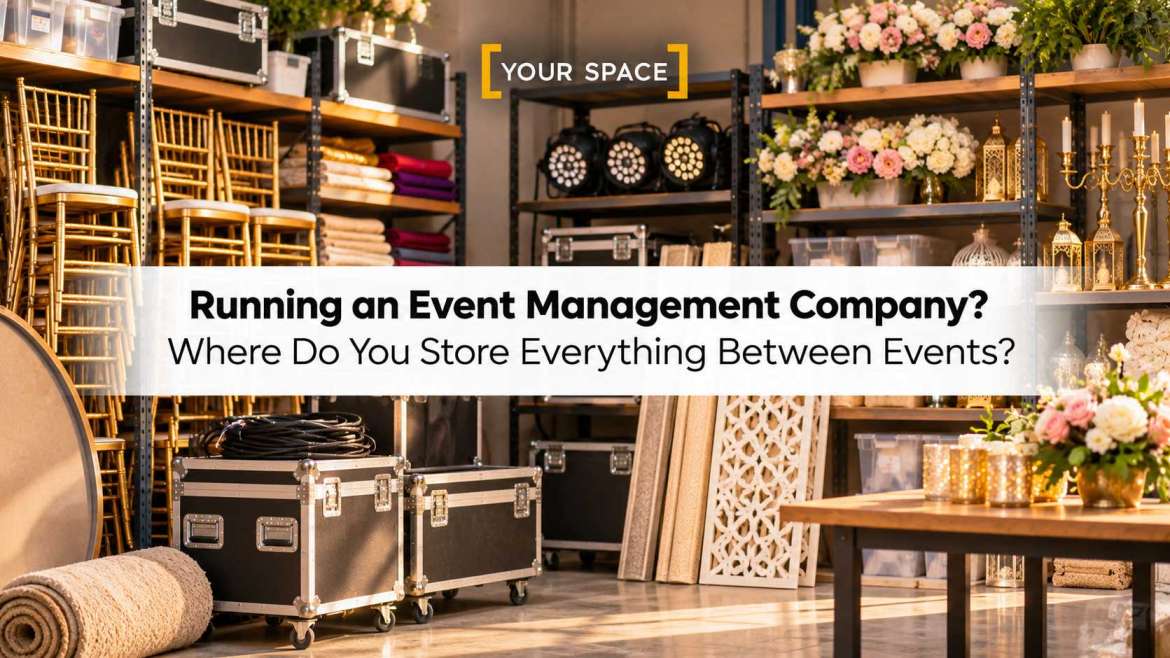
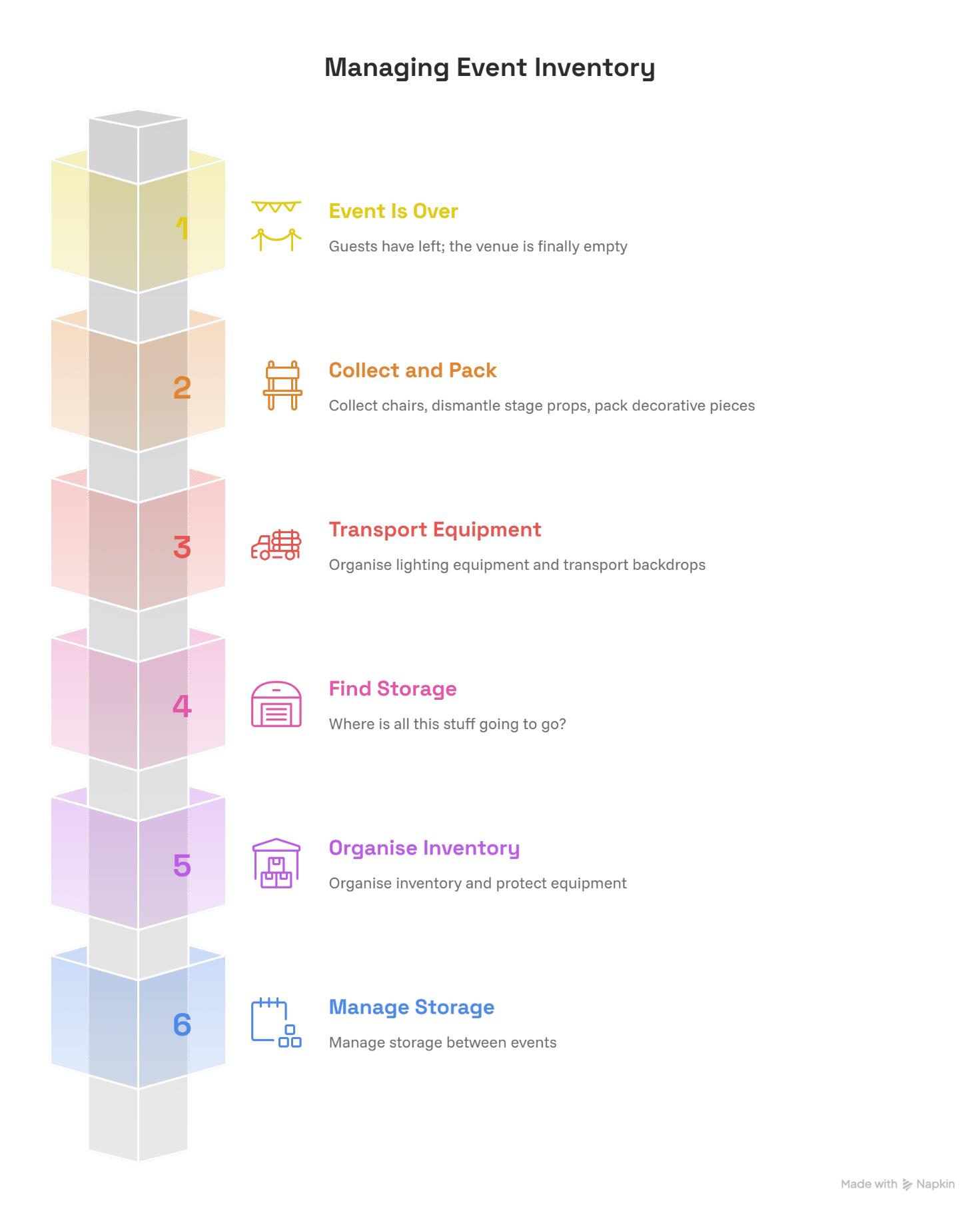
An event is over. The guests have left, the music has stopped, the lights are switched off and the venue is finally empty.
But your work? Not quite finished.
There are chairs to collect, stage props to dismantle, decorative pieces to pack, lighting equipment to organise and backdrops to transport. And once everything is back at your office, there’s one question waiting for you: where is all this stuff going to go?
If you run an event management company, you probably know the struggle. Every successful event adds another collection of reusable décor, furniture, equipment and supplies to your inventory. One day, your office is a workspace. The next, it looks like a warehouse preparing for three weddings and a corporate launch.
Managing events is one thing. Managing everything you use to create those events is another. From wedding planners and exhibition organisers to corporate event agencies and production companies, having a proper storage plan can make a real difference to day-to-day operations.
Let’s explore how event management businesses can organise their inventory, protect their equipment and manage storage between events.
1. Start by Creating an Inventory of All Your Event Equipment
Before thinking about additional storage space, find out exactly what your company owns. Event management businesses often work with a wide variety of reusable materials. Without a proper inventory, it becomes difficult to track what is available, what is being used and what needs repair or replacement.
Start by preparing a list of your equipment under different categories. Furniture covers tables, chairs, sofas, stools and display counters, while stage equipment includes platforms, risers, modular structures and stage accessories. Décor covers artificial flowers, centrepieces, decorative installations and props, and lighting includes LED fixtures, stands, cables and lighting accessories.
Event branding covers backdrops, banners, signboards and display materials. Audio-visual equipment includes screens, projectors, speakers and related accessories, and general supplies include tapes, tools, extension cords and packaging materials.
Maintain basic details such as quantity, condition, storage location and usage. You can start with a spreadsheet and introduce dedicated inventory software as your business grows.
The first rule of organised event storage? Know what you have before buying more.
2. Separate Event Décor, Furniture and Equipment
Imagine your team needs a particular backdrop for a corporate event tomorrow. But it’s somewhere behind a pile of wedding decorations, spare chairs and boxes of lighting accessories. Now a simple collection task has turned into a treasure hunt.
One of the easiest ways to improve event inventory management is to create separate storage zones. Consider dividing your inventory into event furniture (tables, chairs, sofas and stools), stage décor (backdrops, props, platforms and decorative panels) and wedding décor (artificial flowers, centrepieces and decorative accessories).
Corporate event supplies (branding materials, banners and display stands), lighting equipment (fixtures, stands, cables and accessories), audio-visual equipment (screens, projectors, speakers and related gear) and general supplies (tools, tapes, packaging and other event essentials) can each have their own zone as well.
Use clear labels on boxes, shelves and equipment cases. This makes it easier for staff to identify items, prepare event consignments and return materials to the correct locations after an event. The less time your team spends searching for equipment, the more time they can spend preparing for the next event.
3. Store Event Furniture Without Damaging It
Furniture is often among the bulkiest items in an event management company’s inventory. Chairs, tables, sofas, display counters and decorative furniture can occupy considerable space, particularly when a company manages multiple events.
Simply stacking everything together may not be the best approach. Incorrect stacking can cause scratches, dents and other damage.
Here are a few practical furniture storage tips. Clean furniture before putting it away and allow items to dry completely before covering them with suitable protective covers. Separate delicate or upholstered furniture, stack only items designed for safe stacking and avoid placing excessive weight on furniture. Keep an accessible arrangement for frequently used pieces.
For larger furniture collections, plan the storage layout according to dimensions and handling requirements. Also consider how furniture will be moved in and out. Leaving enough room for safe access can make loading and unloading easier.
After all, a chair that comes back scratched from storage isn’t exactly ready for the next big event.
4. Organise Decorations and Props According to Event Type
Every event has a different visual identity. A wedding may need floral arrangements, decorative arches and centrepieces. A corporate launch may require branded backdrops, display panels and promotional installations. Keeping all these materials mixed together can make event preparation unnecessarily complicated.
Instead, organise décor and props according to their purpose or event category. For example, you can group wedding and engagement decorations, corporate event props, exhibition and trade-show materials, and festival and seasonal decorations. Stage backdrops and display panels, and artificial flowers and decorative accessories, can have their own groups too.
Use labelled containers for smaller items such as decorative pieces, artificial flowers, table accessories and reusable props. Fragile items should be packed with suitable protective materials. Larger decorative structures may require dedicated storage arrangements depending on their size and construction.
It can also help to photograph specialised décor items and maintain a visual inventory. This makes it easier for your team to identify the correct materials while planning an event.
5. Give Lighting and Audio-Visual Equipment Extra Attention
Lighting and audio-visual equipment can be expensive and often requires careful handling. From LED fixtures and lighting stands to speakers, projectors, screens and cables, these items should not simply be thrown into random cartons after an event.
A more organised approach includes keeping equipment in suitable protective cases, separating cables according to their use and labelling cases with equipment names. Check items for visible damage after use, keep accessories together with their corresponding equipment and follow manufacturer instructions for storage and handling.
For example, loose cables can quickly become difficult to identify when several event projects are being managed simultaneously. Use labelled cable bags or dedicated organisers to keep them separated.
For sensitive electronic equipment, follow the manufacturer’s recommended temperature, humidity and handling conditions. Not every general-purpose storage area will be suitable. A little extra attention can help reduce avoidable damage and make equipment easier to prepare for the next event.
6. Manage Equipment Movement Between Events
Here’s where things can get complicated. An event management company may handle multiple projects in the same week. While one team is dismantling a wedding setup, another may be preparing for a corporate conference. Equipment is constantly moving between venues, offices and storage locations.
Without a proper tracking process, items can get misplaced, forgotten or returned in poor condition.
Create a simple equipment movement system. Prepare an equipment checklist before dispatch, record which items are assigned to each event and check quantities before loading. When equipment returns, inspect it, record any missing or damaged items and return everything to its designated storage location.
You can also assign responsibility to specific team members for equipment collection and returns. For companies managing several events simultaneously, digital inventory tracking can help maintain better visibility of equipment movement.
The idea is simple: every item that leaves your storage space should have a record of where it’s going and when it’s coming back.
7. Don’t Let Your Office Turn Into an Event Warehouse
Your office is supposed to be the place where your team plans events, coordinates vendors, meets clients and manages operations. But when event inventory starts occupying every available corner, things can quickly get out of hand.
A few cartons become a stack. The stack becomes a storage corner. And before you know it, your meeting room is hosting chairs, decorative props and boxes of lighting accessories.
This creates several challenges: less usable workspace for employees, difficulty locating important event materials and more time spent shifting equipment. Common areas and walkways get cluttered, there is limited space for administrative activities, and preparing materials for upcoming events becomes harder.
Start by separating daily-use office supplies from event inventory. Items needed frequently can remain at your premises, while additional furniture, seasonal decorations, spare equipment and materials for upcoming projects may be better suited to a separate storage arrangement.
Your office should help your business run events, not become the place where every event ends up being stored.
8. Consider External Storage for Event Inventory
Sometimes, organising your existing space simply isn’t enough. As an event management company grows, its inventory grows too. More clients can mean more furniture, additional decorations, larger stage setups and extra equipment. At some point, your office or existing storeroom may no longer be able to accommodate everything comfortably.
This is where external storage can be worth considering. Depending on your business requirements, additional storage space may be useful for bulk event furniture, wedding and corporate event decorations, stage props and backdrops, and lighting and audio-visual equipment. It also suits exhibition and promotional materials, seasonal event supplies, and spare equipment and reserve inventory.
Before choosing a storage solution, consider the following:
Storage capacity: Estimate the volume and dimensions of your inventory.
Accessibility: Identify how frequently your team needs to retrieve equipment.
Handling requirements: Consider the size, weight and fragility of stored items.
Storage conditions: Check whether the environment is appropriate for your furniture, décor and electronic equipment.
Duration: Decide whether you need short-term storage between events or a longer-term arrangement.
The objective is to keep your everyday workspace functional while ensuring that additional inventory has an appropriate place.
9. Prepare Your Inventory for the Next Event Before Storing It
One common mistake is putting everything away immediately after an event without checking its condition. The next time your team needs that equipment, they may discover missing accessories, damaged props or tangled cables.
Instead, introduce a simple post-event storage routine. After every event, check furniture for scratches or damage, clean reusable decorations and props, and inspect lighting and audio-visual equipment. Separate items that need repair, organise cables and smaller accessories and pack fragile materials appropriately. Finally, update your inventory records and return everything to its assigned storage location.
You can also create event-specific equipment kits for frequently repeated setups. For example, a standard corporate event kit might include selected display materials, signage accessories, extension cables and other commonly required supplies. This can make preparation more consistent and reduce last-minute searching.
10. Build an Event Equipment Storage Checklist
A consistent storage routine can make a big difference, especially when multiple employees handle inventory. Use this checklist to review your current equipment management process.
Prepare an updated inventory of all event materials, categorise furniture, décor, lighting and accessories, and assign dedicated storage areas to different equipment types. Label cartons, shelves and protective cases, inspect equipment after every event, and clean and dry reusable materials before storage.
Keep fragile items appropriately protected and track equipment sent to and returned from venues. Separate daily-use inventory from occasional-use materials, review available storage space regularly and consider additional storage when existing space becomes insufficient.
You don’t need an elaborate system to get started. Even a basic checklist and inventory spreadsheet can help bring more structure to your operations.
Frequently Asked Questions About Event Equipment Storage
- How should an event management company store its equipment?
Start by categorising inventory into furniture, décor, lighting, audio-visual equipment and general supplies. Use suitable racks, containers and protective cases, maintain clear labels and keep an updated inventory.
- What is the best way to store event decorations between events?
Clean and dry reusable decorations before storing them. Separate fragile items, use suitable protective packaging and organise materials according to event type or category.
- How can event companies manage large furniture inventories?
Maintain a furniture inventory, group items according to size and type, use appropriate protective covers and follow safe stacking and handling practices. Plan the storage layout to allow easy access.
- How do event management companies prevent equipment from getting lost?
Use dispatch and return checklists, maintain records of equipment assigned to each event and inspect inventory after every project. Digital inventory systems can also help track equipment movement.
- When should an event management company consider external storage?
External storage may be useful when the company has more inventory than its office or existing storeroom can comfortably accommodate. It can help create additional space for furniture, props, decorations and reserve equipment.
- What types of event equipment can be stored in a warehouse?
Depending on the storage facility and its conditions, businesses may store event furniture, stage props, backdrops, decorations, lighting accessories, exhibition materials, promotional supplies and other non-perishable inventory.
Your Next Event Needs Space. So Does Your Inventory!
An event may last a few hours, but the equipment behind it needs to be managed throughout the year. From wedding decorations and stage props to corporate event furniture, lighting equipment and exhibition materials, every successful event leaves behind something that needs to be organised, maintained and stored.
As your event management business grows, having enough space for your inventory becomes just as important as having the right equipment.
Your Space offers storage solutions across Mumbai, Pune and Bengaluru for businesses looking to manage their storage requirements more efficiently. Whether you’re an event planner, wedding management company, exhibition organiser or corporate event agency, explore storage options that can help you keep your workspace organised and your inventory manageable.
Because your next big event deserves a well-prepared team, not a storeroom full of chaos!
Looking for additional storage space for your event inventory?
