
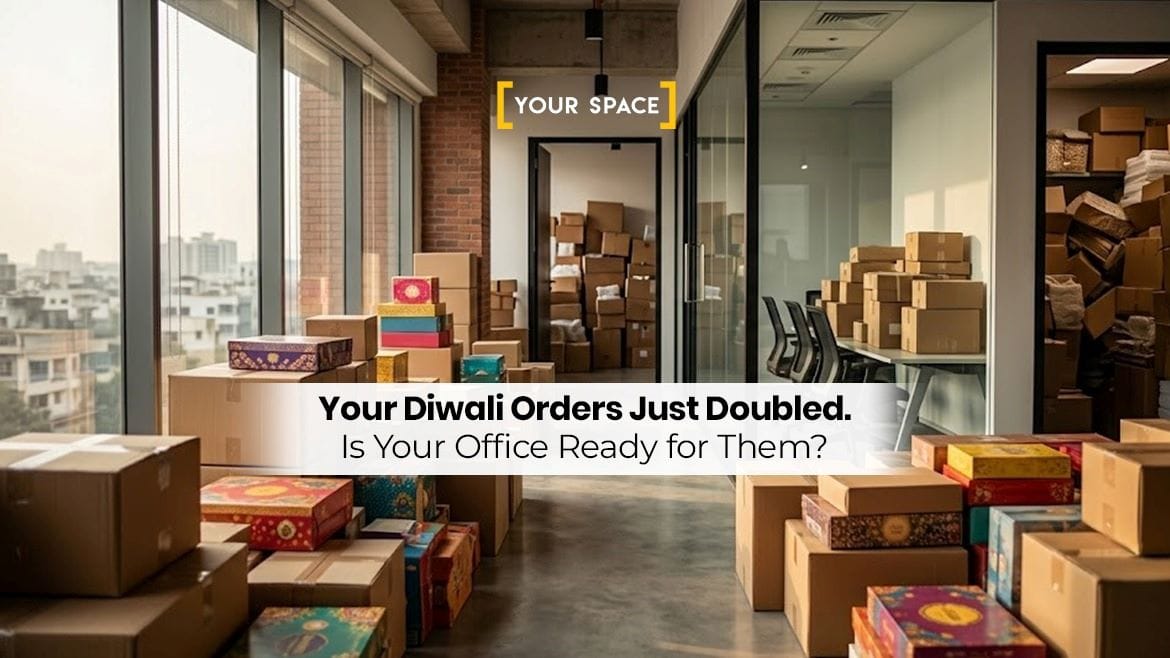
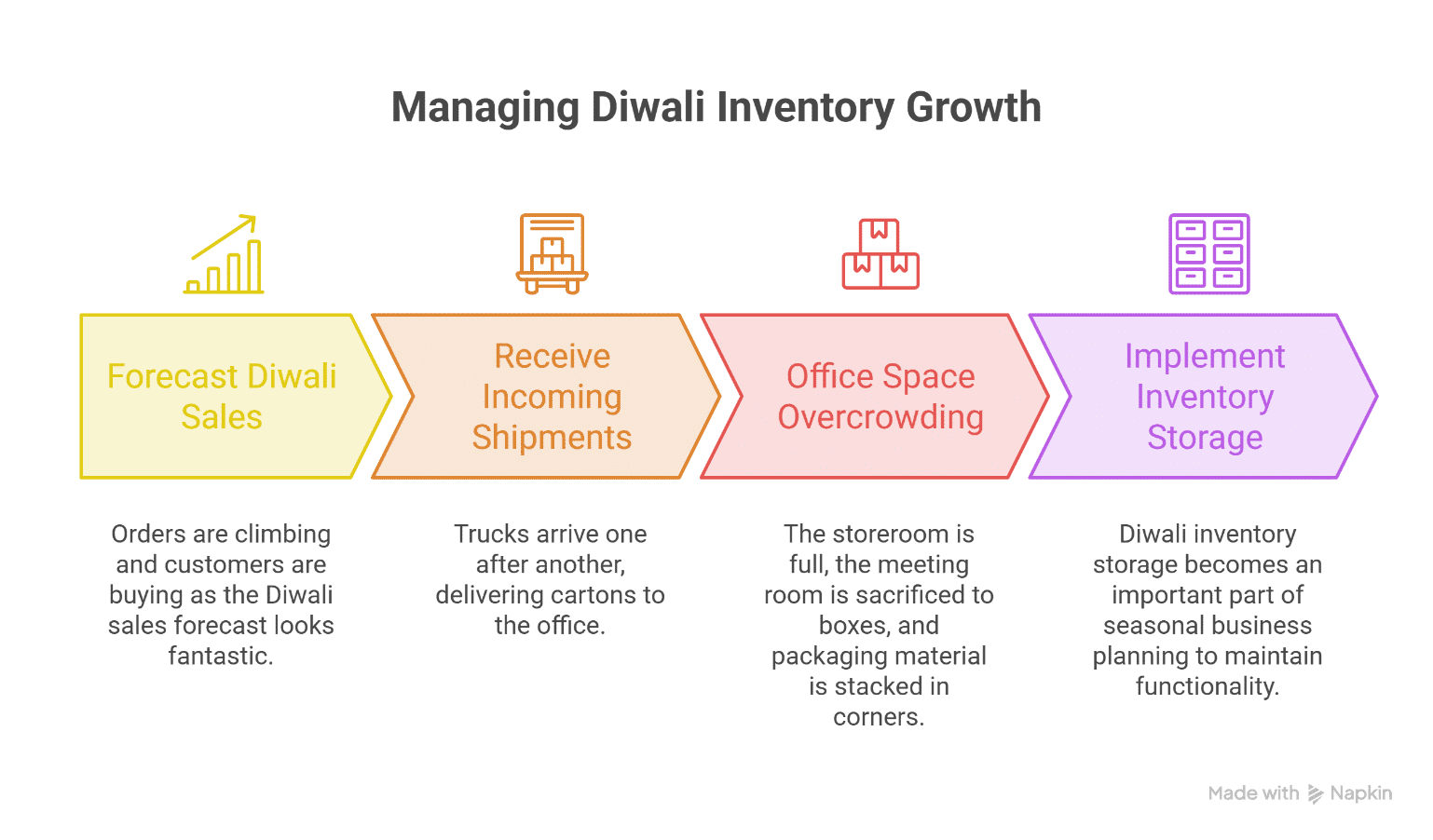
Your Diwali sales forecast looks fantastic. Orders are climbing, customers are buying, and your team is busy — everything sounds like good news, until the first truck arrives. Then another. Then another. Suddenly, your office has more cartons than chairs. The storeroom is full, the meeting room has been sacrificed to boxes, and packaging material is stacked wherever someone could find an empty corner, while the team tries to work around all of it.
The business is growing, but the space isn’t. That’s one of the less glamorous sides of seasonal business growth: more orders mean more physical stuff, and if your business hasn’t planned for that physical volume, Diwali can turn a perfectly functional office into a very inconvenient warehouse. That’s where Diwali inventory storage becomes an important part of seasonal business planning.
Diwali inventory growth management infographic
The Problem with a Good Diwali
Nobody complains about getting more orders — that’s the dream. But every order has a physical footprint. A product needs to arrive somewhere, be stored, and may need to be picked, checked, packed and labelled before it waits for dispatch. Multiply that process by hundreds or thousands of orders, and the amount of space required can change dramatically.
This is especially relevant for small and growing businesses. During normal months, the available office, shop, workshop or storeroom may be perfectly adequate — but Diwali isn’t a normal month. Businesses may stock additional products before demand peaks, corporate gifting companies may prepare large batches of hampers, e-commerce businesses may increase inventory ahead of expected festive demand, and retailers may bring in seasonal merchandise.
And suddenly, the question isn’t simply “How many orders can we handle?” It’s “Where are we going to put everything required to fulfil them?”
When Your Office Quietly Becomes a Warehouse
There’s usually no dramatic moment when this happens — it happens one box at a time. First, someone keeps a few cartons near reception. Then a shelf gets filled. Then the meeting room becomes useful for “temporary storage.” Then someone moves a desk. Then the packaging material arrives. And eventually, everyone knows the office has a storage problem.
The irony is that the business may still be operating from the same amount of space it had before the Diwali rush. The number of orders has changed, the physical inventory has changed, and the packaging requirements have changed — but the office hasn’t. That’s when the lines between office space and storage space begin to blur.
What Actually Starts Taking Up All the Space?
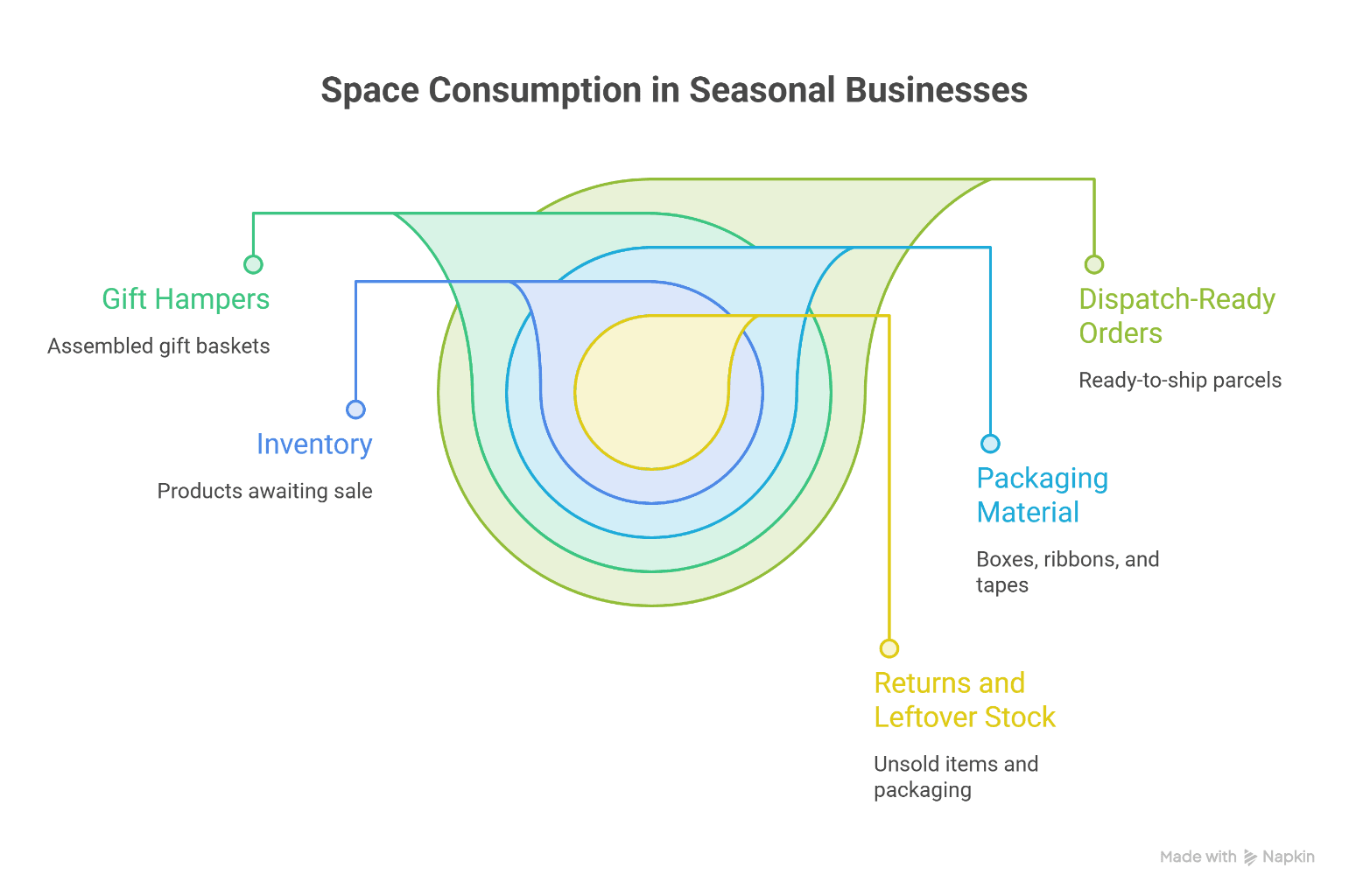
It’s easy to think the problem is simply “too much stock.” In reality, seasonal businesses often need space for several different categories of physical goods.
Inventory
This is the obvious one. Additional products may arrive before the festive demand peaks — for some businesses that might mean a few extra shelves, for others it could mean hundreds of cartons. The important point is to calculate inventory not just by units or rupee value, but also by physical volume: a thousand small products and a thousand large products are very different storage problems.
Packaging Material
Here’s the part businesses often underestimate — the products aren’t the only things taking up space. There are cartons, gift boxes, paper, bubble wrap, labels, tapes, bags, ribbons, filler material, stickers and shipping materials. If the business is creating festive packaging, the packaging itself may require considerable space before it is even used. You can have a perfectly organised inventory system and still have a room full of packaging boxes.
Gift Hampers
Diwali gifting creates another interesting challenge. A business may receive products from multiple suppliers, assemble them into hampers and then hold the finished hampers until the delivery schedule. That means the same business may need space for incoming products, packaging materials, work-in-progress hampers, finished hampers and dispatch-ready orders — different stages of inventory that become harder to manage when treated as one giant pile.
Dispatch-Ready Orders
This is another space requirement that appears late in the process. The order is packed, the label is attached, everything is ready — but the courier pickup isn’t until tomorrow. So where does the parcel go? One parcel isn’t a problem; a few hundred parcels are. A business needs somewhere to temporarily hold dispatch-ready orders without blocking normal operations.
Returns and Leftover Stock
And then comes the part nobody wants to think about before Diwali: what happens afterward? There may be returns, damaged packaging, unsold inventory, excess packaging material, products that didn’t move as expected, and seasonal promotional material. All of this needs somewhere to go — the storage problem doesn’t necessarily end when the festival does.
Why Seasonal Inventory Is Different
Regular inventory follows a relatively predictable rhythm. Seasonal inventory can behave very differently — you may need more stock for a shorter period, receive large shipments close together, and need to process significantly more orders within a compressed timeframe. After the peak, demand may drop again.
That creates an unusual storage requirement: you need more space, but you may not need that space permanently. This is where seasonal inventory storage can make sense for businesses that don’t want to expand their permanent premises simply to accommodate a few high-demand periods. Instead of permanently paying for space that sits underused for much of the year, businesses can consider storage arrangements that match their actual operational requirements.
The Hidden Cost of Storing Inventory in the Office
At first, using office space seems free — you already pay for the office, so why not use every available corner? Because the cost isn’t necessarily the rent. It’s what happens to the business when operational space gets consumed by inventory: a meeting room becomes inaccessible, employees have less working space, stock becomes harder to locate, packing takes longer, movement becomes difficult, important documents or equipment get pushed aside, customers or visitors see a cluttered environment, and your team spends more time navigating around boxes.
There is also an opportunity cost. A square metre being used to store cartons can’t simultaneously be used for another business function. The office is supposed to help your team work; a warehouse is supposed to help your inventory sit, move and get dispatched. Those are two different jobs.
How to Prepare Your Business Before the Diwali Rush
The best time to solve a seasonal storage problem isn’t when everyone is already standing around a pile of cartons — it’s earlier.
Forecast the Physical Volume, Not Just Sales
Businesses often forecast revenue and order numbers. Add one more question: how much physical space will those orders require? Estimate the number of cartons, boxes, products and packaging units you’ll need to accommodate. Even a rough estimate can reveal a potential space problem before it becomes one.
Separate Selling Stock From Packing Stock
Your products and your packaging don’t necessarily need to occupy the same space. Create a logical system for product inventory, packaging material, work-in-progress orders, finished orders and dispatch-ready shipments. The clearer these categories are, the easier it becomes to know what needs to be accessible and what can remain in storage.
Create a Dispatch-Ready Area
A packed order should have somewhere to wait. Don’t allow dispatch-ready orders to slowly spread across desks, corridors and meeting rooms — a clearly defined dispatch area can make a significant difference during high-volume periods.
Identify Slow-Moving and Excess Inventory
Not every item needs to be within arm’s reach. If some inventory isn’t expected to move immediately, it may not need prime operational space. The objective isn’t to hide inventory — it’s to organise it according to how frequently the business needs access to it.
Plan for What Happens After Diwali
This is one of the most important questions. Don’t only ask “Where will we keep the stock before Diwali?” — ask “Where will everything go after Diwali?” That includes leftover inventory, packaging, promotional material and seasonal equipment. A storage plan that ends on the last day of the festival isn’t really a complete storage plan.
When Does a Business Need Additional Storage?
There isn’t one magic number of boxes that tells a business it needs external storage. The better question is whether inventory is beginning to interfere with normal operations. If employees are working around cartons, if the office is losing functional space, if stock is difficult to locate, or if your business needs more room temporarily than its premises can provide, additional storage may be worth considering.
This is particularly relevant for businesses that experience predictable seasonal peaks. Instead of taking on a larger permanent office or warehouse for the entire year, they may need flexible business storage during high-demand periods.
Where 3PL Storage Fits Into the Picture
For businesses dealing with significant order volumes, storage may be only one part of the challenge — there is also inventory handling, order processing, packing, dispatch and logistics coordination. That’s where 3PL can become relevant. Third-party logistics can allow businesses to outsource some logistics and fulfilment activities to an external provider, depending on the services involved.
The bigger idea is simple: your business doesn’t necessarily need to own every square metre required to handle its peak season. Sometimes it makes sense to use specialised infrastructure when demand temporarily expands. For businesses handling festive inventory, the combination of inventory storage and fulfilment support can help separate the workplace from the physical stock operation.
What Happens When You Don’t Plan Storage Early?
The problem usually doesn’t announce itself politely — it starts with small inconveniences. Someone can’t find a product. Then a shipment arrives and there’s nowhere to put it. The packing team needs another table. The office loses its meeting room. Employees start moving boxes around to reach other boxes. A customer order gets delayed because an item is physically difficult to locate.
None of these problems sounds enormous individually. Together, they can create operational friction at exactly the time your business is busiest. And that’s the frustrating part: the business is growing because customers are buying, but the operational experience becomes difficult because there isn’t enough physical infrastructure behind that growth.
The Post-Diwali Problem Nobody Talks About
The festive rush ends. The orders slow down. The office finally becomes quiet again. And then you look around — there are still boxes. Maybe some products remain, maybe there is packaging left over, maybe a few hundred units didn’t sell as expected, maybe the business bought additional stock because running out during Diwali wasn’t an option.
Now you have a new question: what do we do with everything we no longer need every day? This is why seasonal storage shouldn’t be treated as a purely pre-Diwali problem. The smartest plan considers the entire cycle — before Diwali, during Diwali, and after Diwali. Inventory needs somewhere to arrive, somewhere to wait, and somewhere to be processed, and whatever remains afterward needs somewhere appropriate to stay.
Your Office Doesn’t Have to Become Your Warehouse
A growing business needs space, but that doesn’t necessarily mean every bit of that space has to be inside the office. Your team needs desks. Your customers need service. Your operations need room to function. Your inventory needs somewhere safe and organised to stay. Those requirements can coexist without forcing the office to do every job at once.
For businesses facing a temporary festive surge, business storage, inventory storage or 3PL solutions can provide additional physical capacity without turning the workplace into a maze of cartons. Because the goal isn’t simply to find somewhere to put the boxes — the goal is to keep the business moving while the boxes are there.
Final Thoughts
A doubling of Diwali orders is a good problem to have, but it is still a problem if the business isn’t physically prepared for it. More orders mean more inventory, more inventory means more space, and more space means more than another shelf in the corner. It means thinking about where products arrive, where they wait, where they are packed, where finished orders sit, and what happens to everything left after the festive rush.
So before Diwali gets busy, take a walk around your office. Look at the empty corners, look at the storeroom, look at your packing area. Then ask yourself one simple question: “If our orders doubled tomorrow, where would everything go?” If the answer is “We’ll figure it out,” you may want to figure it out before the cartons arrive — because during Diwali, the problem isn’t having too many orders. It’s having nowhere to put the success.
Frequently Asked Questions
What is Diwali inventory storage?
Diwali inventory storage refers to storing additional business stock, packaging materials, gift hampers and other festive inventory in a suitable storage facility during the Diwali season.
Why do businesses need additional storage during Diwali?
Seasonal demand can increase the amount of inventory and packaging a business needs to hold. Businesses may require additional space temporarily without wanting to expand their permanent office or warehouse.
What can businesses keep in Diwali storage?
Depending on the business, storage may include products, gift hampers, packaging materials, promotional items, dispatch-ready orders, seasonal merchandise and leftover inventory.
Is business storage useful for small businesses?
It can be useful when a small business has limited premises but experiences temporary increases in inventory volume during festive or seasonal periods.
What is 3PL storage?
3PL, or third-party logistics, involves outsourcing some logistics and fulfilment activities to an external provider. Depending on the arrangement, this can include inventory storage, handling, packing and fulfilment support.
What should businesses do with leftover Diwali inventory?
Businesses can assess leftover stock based on expected future demand, resale potential, seasonality and storage requirements. Inventory that isn’t needed immediately may be moved into appropriate longer-term or seasonal storage.
When should a business arrange Diwali inventory storage?
Ideally, businesses should assess their storage requirements before seasonal inventory begins arriving. Planning early gives them more opportunity to organise inventory and avoid operational disruption during the peak period.
Can packaging materials be stored separately from inventory?
Yes. Separating products from packaging materials can make inventory management and fulfilment more organised, particularly when businesses handle large festive order volumes.
Diwali Orders Are Growing. Is Your Storage Space Keeping Up?
If your business is preparing for a festive rush, you don’t have to turn your office into a warehouse.
Your Space Doctor provides storage solutions for businesses dealing with additional inventory, seasonal stock, packaging materials and other physical business requirements.
Whether you need extra space for Diwali inventory, e-commerce stock, corporate gifting materials or seasonal business belongings, the right storage setup can help you keep your workplace focused on operations.
📞 Call +91 8433925040 to discuss your business storage requirements.
Your orders can grow. Your office doesn’t have to overflow with boxes.
