
Imagine 30 Days Without Bringing Another Thing Into Your Home
Imagine waking up tomorrow and making yourself a simple promise:
For the next 30 days, I’m not buying anything I don’t genuinely need.
No random online orders.
No “it’s only ₹499” purchases.
No extra cushion because it looks nice.
No kitchen gadget because someone recommended it on Instagram.
No clothes bought just because there’s a sale.
No decorative item because you have a discount coupon sitting in your inbox.
Food, medicines, essential household supplies and genuine necessities are fine.
Everything else?
It waits.
At first, it sounds easy.
Then you open your favourite shopping app.
And suddenly that ₹799 organizer looks extremely important.
That’s the interesting part of a 30-day no-buy challenge.
It isn’t really about surviving without shopping.
It’s about discovering how often you shop without actually needing anything.
And there’s another surprise waiting at the end of the challenge.
Your home may look different too.
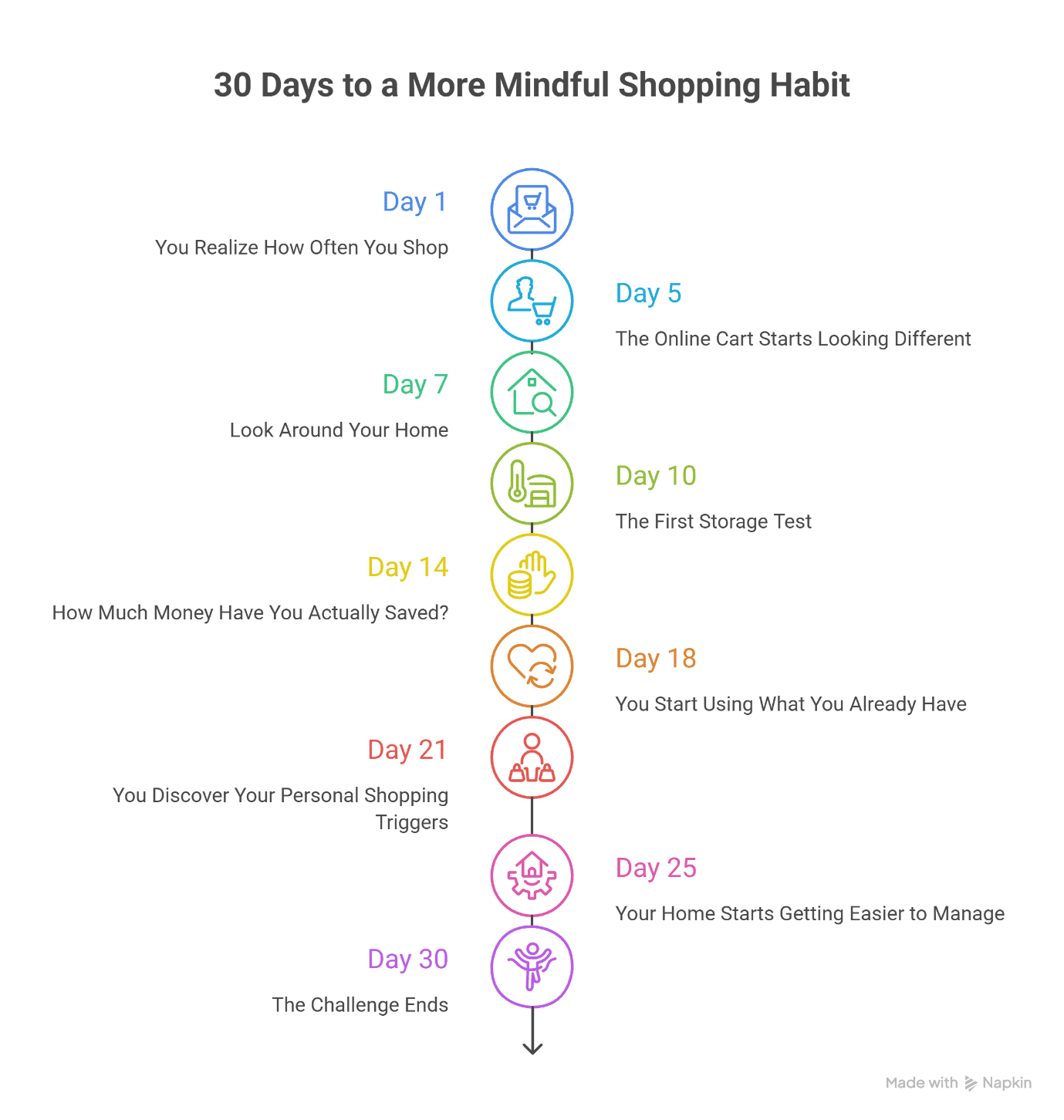
Day 1: You Realize How Often You Shop
The first day usually feels surprisingly normal.
You don’t buy anything.
That’s it.
But then you start noticing how often shopping opportunities appear.
A notification pops up.
“Only 3 hours left.”
An email arrives.
“Extra 20% off.”
Someone shares a product link in a WhatsApp group.
You see a new home décor trend while scrolling.
A friend mentions a new restaurant appliance, skincare product, jacket or gadget.
You don’t necessarily buy everything.
But you notice how often you’re being encouraged to buy something.
That’s the first lesson of the challenge:
Shopping isn’t always a response to a need. Sometimes the opportunity creates the desire.
Day 5: The Online Cart Starts Looking Different
By the fifth day, something strange happens.
You start adding things to your cart without checking out.
A new pair of shoes.
A storage basket.
A phone accessory.
A shirt.
A coffee mug.
A gadget.
Then you stop.
“Do I actually need this?”
Sometimes the answer is yes.
Often, it’s no.
And that’s where the no-buy challenge becomes useful.
You aren’t banning yourself from ever buying anything again.
You’re simply creating enough space between wanting something and buying it to make a better decision.
Day 7: Look Around Your Home
Now do something slightly uncomfortable.
Walk around your home.
Open a cupboard.
Check the kitchen.
Look under your bed.
Open the wardrobe.
Look inside that drawer where random things go.
Then ask yourself:
“If I already own this much, why do I keep bringing more things inside?”
Maybe you find clothes you forgot about.
A kitchen appliance you used twice.
Three almost-identical water bottles.
Old chargers.
Unused notebooks.
Decorations from a festival two years ago.
A box of something you bought because it was “too good a deal to miss.”
This is where decluttering becomes interesting.
The problem isn’t always that your home is too small.
Sometimes, your belongings simply keep arriving faster than you’re able to use them.
Day 10: The First Storage Test
By now, you’ve stopped buying unnecessary physical things for ten days.
That sounds insignificant.
But think about what hasn’t entered your home.
No extra shopping bags.
No new clothes.
No random packages.
No new décor.
No impulse purchases.
Nothing new needs a permanent home.
And suddenly, you begin to understand something about household storage.
Storage doesn’t only deal with the things you already own.
It also has to deal with the constant stream of things coming into your home.
If that stream never slows down, cupboards eventually fill again.
No matter how many storage boxes you buy.
Day 14: How Much Money Have You Actually Saved?
This is where the challenge gets interesting financially.
Don’t just calculate the large purchases you avoided.
Look at the little ones.
₹399 here.
₹699 there.
₹1,200 because there was a sale.
₹850 for something you thought would make life easier.
None of these purchases individually feels dramatic.
But add enough of them together and the number can become surprisingly large.
Try this:
Write down every purchase you considered making during the challenge.
Then write down:
What it cost.
Why you wanted it.
Whether you still want it.
You might discover that some things felt urgent for approximately twelve minutes.
Day 18: You Start Using What You Already Have
This is perhaps the best part.
When you’re not constantly thinking about what to buy next, you start noticing what you already own.
That forgotten shirt suddenly becomes useful.
The old serving bowl gets used.
The unopened stationery gets pulled out.
The exercise equipment gets another chance.
The books you’ve been meaning to read are still sitting there.
The kitchen appliance you bought months ago finally gets used.
Your home starts feeling a little less like a showroom of future intentions and a little more like a place you’re actually living in.
Day 21: You Discover Your Personal Shopping Triggers
By the third week, patterns begin to emerge.
Maybe you shop when you’re bored.
Maybe you shop after a stressful workday.
Maybe you buy things when you’re celebrating.
Maybe sales make you feel like you’re saving money even when you’re spending.
Maybe you shop because everyone else seems to have something new.
None of this makes you a bad shopper.
It’s simply useful information.
Once you know your triggers, you can create better habits around them.
Day 25: Your Home Starts Getting Easier to Manage
There’s another benefit people don’t always expect.
Fewer purchases can mean less maintenance.
Every new object eventually needs something.
It needs to be:
- Cleaned
- Organized
- Charged
- Repaired
- Folded
- Washed
- Moved
- Stored
- Found
A ₹500 item doesn’t necessarily cost only ₹500.
It also occupies a small piece of your attention.
Multiply that across hundreds of possessions and you begin to understand why managing a home can sometimes feel exhausting.
Day 30: The Challenge Ends
Congratulations.
You made it through 30 days.
Now comes the most important question:
What did you learn?
Maybe you saved money.
Maybe you discovered that you already own everything you need.
Maybe your cupboards look exactly the same.
That’s okay too.
The goal was never to become someone who never buys anything.
The goal was to understand your relationship with buying.
The 30-Day No-Buy Challenge: What Should You Actually Track?
Make the challenge more interesting by tracking four things.
| Track This | What to Record |
| 💰 Money | How much you almost spent |
| 📦 Clutter | How many physical items you avoided bringing home |
| 🏠 Space | Which areas of your home feel easier to manage |
| 🛒 Habits | What triggered you to want something |
At the end of the month, look at your answers.
You may find that your biggest achievement wasn’t the money.
It was the space.
Try the “Would I Buy This Again?” Test
Here’s a simple game.
Pick ten random things in your home.
Ask yourself:
“If I didn’t already own this, would I buy it today?”
Be honest.
You might discover:
“Absolutely.”
“Probably not.”
“I have no idea why I bought this.”
That last answer is surprisingly common.
And it’s exactly why mindful shopping matters.
Not Everything Needs to Be Thrown Away
There’s an important point here.
Decluttering doesn’t mean filling ten garbage bags and throwing everything out.
Some belongings are useful.
Some are sentimental.
Some are seasonal.
Some are expensive.
Some simply aren’t needed every day.
That’s where smart space optimization comes in.
Your everyday living space should primarily contain the things you actually use and enjoy regularly.
Seasonal clothing can be organized separately.
Wedding belongings can be stored safely.
Travel equipment doesn’t need to occupy your wardrobe year-round.
Important documents can be kept separately.
Furniture you aren’t currently using doesn’t necessarily need to be discarded.
Sometimes the answer isn’t:
“Get rid of it.”
It’s:
“Does this really need to live here?”
What If You Need the Space But Don’t Want to Let Go?
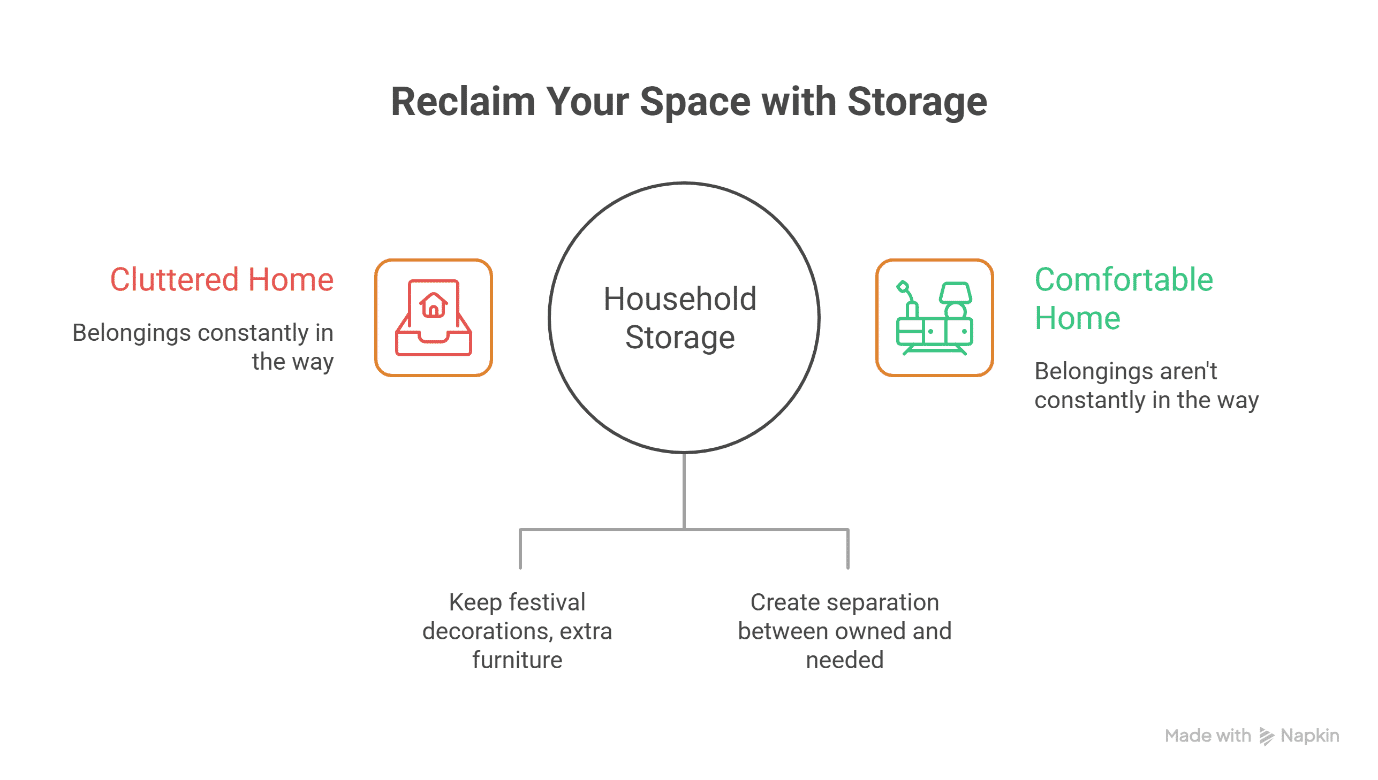
This is where household storage can become useful.
Perhaps you’re keeping:
- Festival decorations
- Extra furniture
- Seasonal clothing
- Childhood belongings
- Wedding items
- Travel equipment
- Collectibles
- Business inventory
You don’t want to throw them away.
But you also don’t want your home filled with boxes.
A practical storage solution can create separation between the things you own and the things you need around you every day.
That’s an important distinction.
A comfortable home isn’t necessarily a home with fewer belongings.
It’s a home where your belongings aren’t constantly getting in your way.
The Real Lesson of 30 Days Without Shopping
Maybe you discover that you don’t need a new wardrobe.
Maybe the kitchen doesn’t need another appliance.
Maybe the living room doesn’t need another decorative piece.
Maybe the storage cupboard isn’t actually too small.
Maybe you simply needed to stop filling it.
That’s the uncomfortable—and strangely freeing—lesson of the 30-day no-buy challenge.
Every purchase eventually becomes someone’s responsibility.
Someone has to clean it.
Organize it.
Repair it.
Move it.
Store it.
And sometimes, eventually, decide what to do with it.
So before buying something because it’s cheap, trending, convenient or available for “just today,” try asking one question:
“Where will this live?”
If you don’t have an answer, maybe you don’t need the purchase yet.
Try the Challenge Yourself
Your 30-Day No-Buy Challenge Starts Today
For the next 30 days:
Don’t buy non-essential physical items.
Then track:
Week 1
What are you tempted to buy?
Week 2
How much money have you avoided spending?
Week 3
What belongings have you rediscovered at home?
Week 4
Has your relationship with shopping changed?
And on Day 30, ask yourself:
“What did I actually miss buying?”
The answer might tell you more than any shopping list ever could.
Frequently Asked Questions
What is a 30-day no-buy challenge?
It’s a personal challenge where you avoid non-essential purchases for 30 days while continuing to buy genuine necessities such as food, medicine and required household items.
Does a no-buy challenge mean you can’t buy anything?
Not necessarily. The rules are personal. Most people focus on avoiding unnecessary or discretionary purchases rather than essential expenses.
Can a no-buy challenge help with decluttering?
Yes. When fewer physical items enter your home, you reduce the amount of new clutter that needs to be organized, stored or eventually removed.
How can a no-buy challenge save money?
It creates a pause between wanting something and purchasing it. Tracking purchases you avoided can show how much money would otherwise have been spent on non-essential items.
What should I do with things I already own but rarely use?
Consider whether each item should be kept nearby, organized elsewhere, donated, sold, recycled or stored. Not everything has to be thrown away simply because you don’t use it every week.
Can household storage help after decluttering?
Yes. Storage can be useful for belongings you genuinely want to keep but don’t need in your everyday living space, such as seasonal items, furniture, wedding belongings or collectibles.
The Challenge Doesn’t End on Day 30
The best outcome isn’t becoming someone who never shops.
It’s becoming someone who thinks before bringing something home.
Because every new purchase needs somewhere to live.
And when you start asking that question before you reach the checkout button, something changes.
You buy more intentionally.
Your home stays easier to manage.
Your cupboards breathe a little.
And perhaps most importantly, you start appreciating what you already have.
Thirty days without unnecessary shopping might not change your entire life.
But it might change what you bring through your front door.
Ready to Make More Space?
Your Home Doesn’t Always Need More Storage. Sometimes It Needs More Breathing Room.
If your home is already full of things you genuinely want to keep, you don’t necessarily have to throw them away.
Seasonal clothing, furniture, wedding belongings, collectibles and other rarely used possessions can be moved into secure household storage, giving you more usable space without forcing you to part with things that matter.
Want to reclaim your space? Talk to Your Space Doctor today.
