
You’re Not Fighting About the Dishes
At least not really.
The dishes are just the symptom.
The real argument started much earlier.
When one person wanted friends over on a Friday night.
And the other person wanted silence.
When one person left things everywhere because the house felt “lived in.”
And the other person quietly spent twenty minutes putting everything back where it belonged.
Welcome to modern shared living.
Where relationships often collide not because people are incompatible…
But because their relationship with space is completely different.
And if you’ve ever shared an apartment with a partner, roommate, sibling, or family member…
You already know.
Space isn’t just physical.
It’s emotional.
The Hidden Personality Test Called Your Home
Here’s something fascinating.
Two people can live in the exact same apartment…
And experience it completely differently.
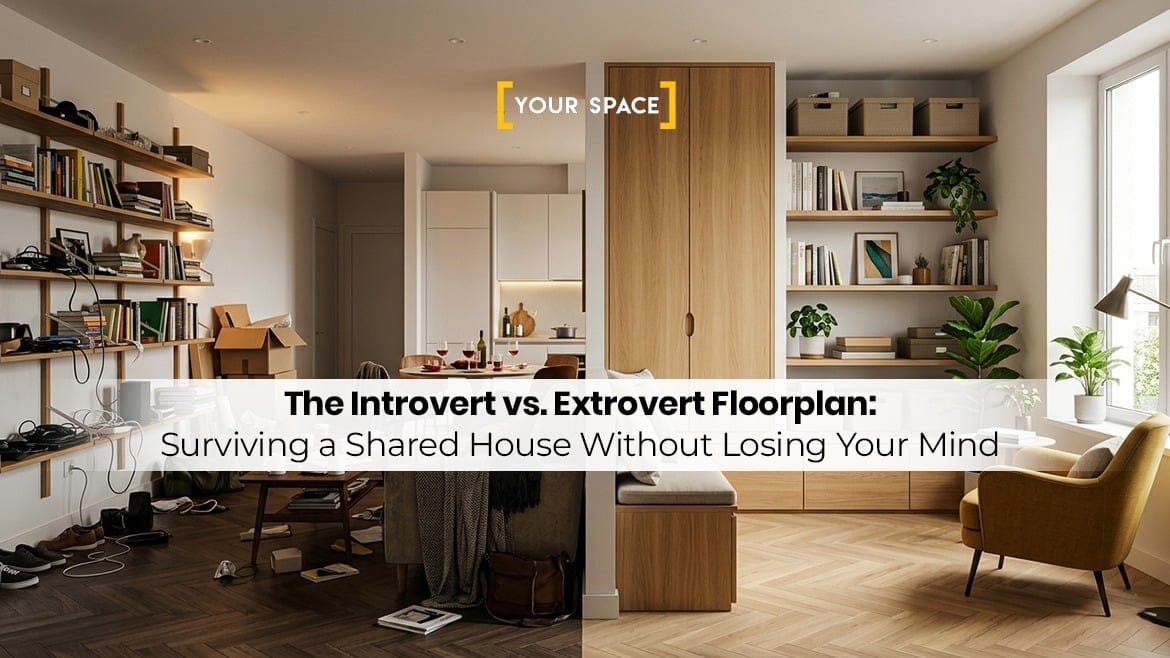
An extrovert sees:
- a gathering space
- an entertainment zone
- a social hub
An introvert sees:
- a recharge station
- a quiet sanctuary
- a place to recover from the outside world
Neither person is wrong.
They’re simply using the same square footage for different psychological needs.
That’s why shared living spaces become challenging.
Not because there’s too little room.
Because people use rooms differently.
Why Small Apartments Magnify Every Difference
In larger homes, people naturally spread out.
But in apartments?
Everything overlaps.
Work space becomes dining space.
The living room becomes a guest room.
The bedroom becomes an office.
And suddenly every habit becomes visible.
This is why urban couples often feel like they’re “on top of each other.”
The issue isn’t always the relationship.
It’s the layout.
The Introvert Floorplan
Introverts aren’t anti-social.
They’re energy managers.
They recharge through:
- quiet
- solitude
- predictable environments
This means they often need:
A Retreat Corner
A dedicated spot that belongs only to them.
Even if it’s
- one chair
- one desk
- one reading corner
Psychologically, it matters.
Visual Calm
Too much visual clutter can feel overwhelming.
This is where household storage solutions help dramatically.
Less visible clutter often means less mental noise.
Predictability
Introverts generally prefer spaces that feel organized and familiar.
A constantly changing environment can feel exhausting.
The Extrovert Floorplan
Extroverts process energy differently.
They recharge through interaction.
This means they naturally prefer:
Open Social Spaces
Areas designed for:
- conversation
- hosting
- shared experiences
Visible Activity
Extroverts often enjoy signs of life around them.
Books out.
Projects visible.
People moving through spaces.
Flexible Layouts
Instead of fixed zones, extroverts often prefer adaptable spaces.
The Real Secret: Shared Zones and Personal Zones
Most couples try to share everything.
That’s the mistake.
Healthy shared living spaces usually have:
Shared Zones
Living room
Kitchen
Dining areas
Protected Zones
Personal desks
Reading corners
Gaming spaces
Creative workstations
Even tiny homes need boundaries.
Why Clutter Creates Relationship Friction
Let’s be honest.
Many arguments are storage problems disguised as relationship problems.
Because when homes become crowded:
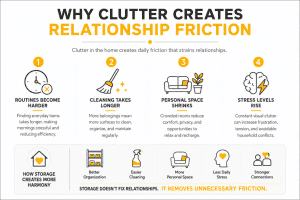
- routines become harder
- cleaning takes longer
- personal space shrinks
And stress rises.
This is why household storage and space optimization often improve harmony at home.
Not because storage fixes relationships.
Because it removes unnecessary friction.
The Space Invader vs. The Space Hoarder
Every shared household has one.
Sometimes both.
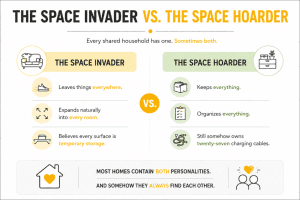
The Space Invader
Leaves things everywhere.
Expands naturally into every room.
Believes every surface is temporary storage.
The Space Hoarder
Keeps everything.
Organizes everything.
Still somehow owns twenty-seven charging cables.
Most homes contain both personalities.
And somehow they always find each other.
The 80/20 Rule for Shared Homes
Here’s a simple strategy.
If 80% of frequently used items are easy to access…
And 20% of less-used items are stored separately…
Homes feel significantly calmer.
That’s why many people use the following:
- box storage
- seasonal storage
- household storage solutions
to free up everyday living space.
The Goal Isn’t More Space
It’s Better Space
Most people assume they need the following:
- a bigger apartment
- another room
- more furniture
But often…
They simply need clearer boundaries.
Better organization.
Smarter storage.
And a little understanding of how different people experience home.
Before You Blame Your Partner, Ask This
Is the problem really the person?
Or is the space working against both of you?
Because sometimes improving a relationship starts with improving the room.
Before You Rearrange Your Home, Read This
Why do couples argue about household space?
Different personalities often have different needs for privacy, organization, and social interaction.
How can small apartments feel larger?
Better organization, household storage solutions, and defined activity zones can dramatically improve space usage.
Do introverts need separate spaces?
Most introverts benefit from having a dedicated area where they can recharge without interruption.
How can storage improve shared living?
Storage reduces clutter, creates more usable space, and minimizes daily friction between household members.
What is the best layout for shared living spaces?
A balance of shared zones and personal zones usually works best.
Sometimes You Don’t Need a Bigger House, You Need a Better System
A calmer home starts with smarter space management.
Call us: +91 8433925040
Visit: Your Space
